Showing posts with label Tree Damage. Show all posts

Thursday, February 3, 2011

Can My Tree Be Fixed?

Contributing Writer - Mike Galvin, Deputy Director

In our prior post, we discussed how to inspect trees for damage following a storm. Today we will discuss the question "what types of damage can be fixed and what types cannot?"

Uprooting is very difficult to fix for any but the youngest trees. As the size and age of the uprooted tree increases, so do two other factors: the cost of the repair and the likelihood that the repair will not be successful.

Stems are assessed on the type of defect, the size of the defect, and what type of conditions you expect the tree to withstand. Hollow trees are common, and as long as the trunk is no more than two thirds hollow, that is not a concern under normal conditions.

Limbs are assessed as stems are. In addition, the closer a side branch is in width to the branch it is growing out from, the greater the likelihood that the limb will break off (these are called co-dominant limbs; stems can also be co-dominant if a tree is multi-stemmed). Limbs that have lost 50% or more in a storm are candidates for removal.
 
The hazard zone can be described in many ways depending on where on the tree the defect is, but the simplest way to describe it is to walk as far away from the tree as the tree is tall, and to “draw” a circle around the tree this way and then look at what falls within the circle. Is it your house? A street? These items are considered “targets”.  A target is generally a person or piece of property that would get damaged or hurt if the tree or part of the tree fell.

All treatments can be boiled down to three options:
  1. Remove the risk by removing potential targets (move any potential targets such as people and property out of the hazard zone).
  2. Mitigate the risk by repairing the damage by pruning, cabling, etc.
  3. Remove the risk by removing the tree.
In urban settings, the first option is often off the table due to site constraints. This means you can either prune or remove the tree, depending on the extent of the damage. Again, if you need these services, we recommend you contact a professional Certified Arborist for help. If you have to remove your tree Casey Trees has a number of programs that may help you with a replacement tree.

Tuesday, February 1, 2011

Is My Tree Damaged?

Contributing Writer - Mike Galvin, Deputy Director


As we are in the midst of another stormy winter, we wanted to share some information on trees and storms. This first of a two part series will help you answer the question: is my tree damaged? A subsequent post will help you answer the question: if so, what can I do about it?

In The Body Language of Trees, a handbook for failure analysis, Claus Mattheck and Helge Breloer set out a process for performing Visual Tree Assessment (VTA). The 3-step VTA method should be used to confirm the presence of a defect. If a defect is found, it should be further investigated.

Mattheck and Breloer propose that we can inspect a tree for defects by reading its body language. Trees grow in ways that make sense. The roots provide stability and water and nutrient uptake. The crown (leaves) provides leaf surface, and so represents food-generating potential through photosynthesis. The stem connects the top and the bottom, providing connectivity and support. Trees grow according to the Axiom of Constant Stress, which states that an optimal structure has a uniform stress over the whole of its surface. So trees invest material to reduce mechanical stress. If you see something that does not look normal it is a cue to further investigation.

Walk 360 degrees around the tree of at all possible. Look at the roots, then the trunk, then the crown. Be careful! There may be damaged or hanging limbs in the crown – they could cause injury if they fall. Some common types of failure associated with storms are uprooting, stem failure, and limb failure.

If the tree is leaning and there is a soil mound or exposed roots on one side of the tree, it could indicate that the root system is failing. Indicators of potential stem failure include cracks, bulges, cavities, and bent stems that do not return to vertical after snow or ice loading. Limb failure indicators are similar to those for stems.

So walk all the way around your tree and inspect it from roots to crown. If you see something that doesn’t look “normal” (a crack, break, lean, etc.) it is a flag that something may be wrong. In such cases, we recommend that you hire a Certified Arborist to inspect and treat your tree to minimize risk.

On Thursday, we will discuss which types of damage can be fixed and which types cannot.

Tuesday, June 15, 2010

NO NO WEEK - TREES ARE NOT MESSAGE BOARDS


Tall, cool and commanding, that tree outside your door seems like the ideal spokesperson for your upcoming yard sale or to announce to the world just how much you love the holidays.

But, before you grab your construction paper and twine, or strings of lights, consider the potential harm of using trees as signposts and permanent beacons of holiday cheer.


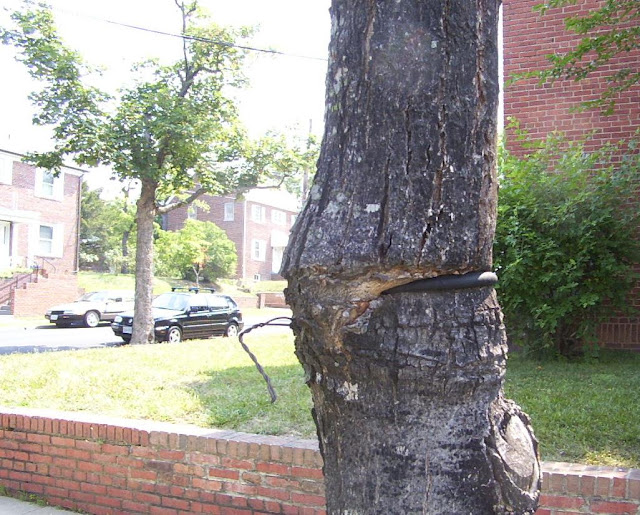
Girdling - Twine, wire or hose, all of these thing can cut into the trunk of a tree. As noted in yesterday's post, a tree's vascular system is located directly under the bark. Like a constricting snake these seemingly innocuous cords can girdle the tree, preventing vital water and nutrients from getting to where they are needed.

Holiday Lights - Everyone enjoys a holiday light show but these little beacons of joy can girdle trees if left on after the holidays. Strings of lights should also never be added around the trunks of trees to create permanent light shows. Two eastern redbuds in front of Hostelling International show scaring on their trunks from just such an oversight.

As you can see, hanging from trees is not the way to go, but hanging with trees is a different story! Find a time to hang out with some trees by checking out our upcoming Programs and Classes.

Friday, February 26, 2010

A MIGHTY WIND BLOWS

According to storm rating scales, trees can be expected to shed twigs when winds reach around 40 mph. When winds reach around 55 mph, trees can be expected to break or uproot. Large, healthy trees should be expected to experience major breakage or uprooting until winds reach over 100 mph.

The National Weather Service is reporting that today’s winds will be from the northwest at 25 to 35 mph with gusts of 55 to 60 mph and locally higher gusts. This means that trees damage can be expected as follows:
  • Small twigs and limbs on structurally sound trees of all sizes;
  • Uprooting of shallow rooted trees and trees in restricted rooting areas in areas where gusts reach maximum levels; and,
  • Breakage of defective limbs and trunks on trees of all sizes in areas where gusts reach maximum levels.
To report damage to street trees, call the Mayor's Comment Line at 311 and request the Urban Forestry Administration (UFA) come out to prune or remove the tree. If a tree on private property is damaged, contact a certified arborist. You can find a certified arborist on the International Society of Arboriculture website.