Showing posts with label Casey Trees Map. Show all posts

Thursday, June 23, 2011

Summer Tree Spots: National Zoo

If you live in or have ever visited the Washington D.C. area, you have spent an afternoon at the family-friendly Smithsonian National Zoological Park.

The lions, tigers and bears are impressive but so is the Zoo's diverse collection of trees. Tree species you can find throughout include Himalayan pine, Turkish hazel, green and white ash, yellowwood and golden catalpa. Although trees usually take a back seat to the animals - especially the pandas - the National Zoo is one of the best places in D.C. to practice your tree identification skills and find some cooling shade during our notoriously hot summer months.

photo
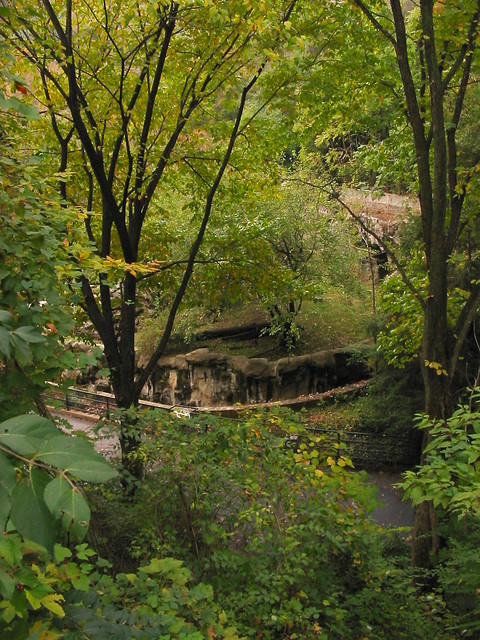
A moment of serenity in the National Zoo. Photo credit: Mo Kaiwen

While we have yet to coordinate a Community Tree Planting (CTP) event at the Zoo - hint, hint - we have coordinated GIS scavenger hunts for our Summer Crew team members on the grounds and helped the Smithsonian Institution do an inventory of their trees. If you want to check out some of the Casey Trees-planted trees nearby, stroll down to Kalorama Park in Adams Morgan. Casey Trees hosted CTPs at Kalorama Park in the fall of 2008 and 2005. You can also locate other Casey Trees-planted trees in close proximity to the Zoo using the Casey Trees Map.

The Zoo is Metro accessible, free to the public and open 10:00 a.m to 6:00 p.m. during the summer. If you haven't visited the Zoo recently, find some time this summer to enjoy all its natural offerings - trees and animals alike.

Thursday, June 9, 2011

Summer Tree Spots: Fort Dupont Park

Staying in town this weekend and need suggestions for where to go? All this summer we’ll highlight spots across the District boasting tree canopies that make them ideal locations for an afternoon picnic, relaxing walk or bike ride.

This week’s Summer Tree Spot is Fort Dupont Park. Located in Southeast D.C. at the intersection of Minnesota and Massachusetts Avenues and adjacent to Ridge Road, Fort Dupont is a historic site that once defended the District from Confederate attack in the Civil War. The 400-acre sites features a hiker-bike trail, athletic courts and fields, picnic areas and community gardens. Remains of the fort are quite evident (located at the picnic groves off of Alabama Avenue SE) along with an amazing and diverse urban forest.

Bike path in Fort Dupont Park. Photo Credit: dannyfowler
Fort Dupont is home to a wide range of tree species, many of which are native to the Washington area. Whether you are a Certified Arborist or just simply want to seek refuge in the shade on a warm summer’s day, the park’s impressive selection of tree species is a sight anyone can appreciate. By the Minnesota and Massachusetts Avenues entrance there are clusters of silver maple; black locust; and southern chestnut. Another section of the park is native woodlands, comprised of chestnut oaks, boxelders, sycamores and American beeches.

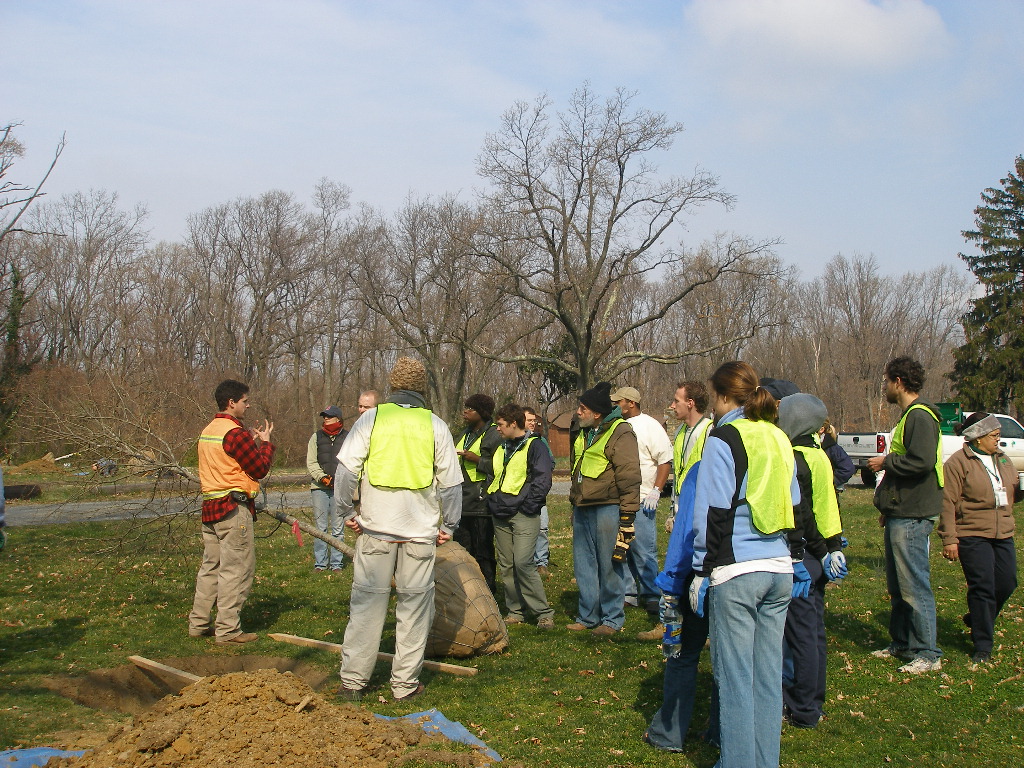
In Spring 2006, Casey Trees hosted a Community Tree Planting event at Fort Dupont Park. You can view  photos from this event on our Flickr photo archive and locate the Casey Trees-planted trees there using the Casey Trees Map. Why not take a walk or ride to Fort Dupont and take a look at how our trees are doing in person? Fort Dupont Park is metro accessible and parking is available on site.

Casey Trees volunteers after a Community Tree Planting at Fort Dupont in March, 2006.

Wednesday, December 15, 2010

Fall CTP Season Recap

Met Branch Trail CTP 12-11-10
WOW! This fall, with the help of almost 1,000 volunteers and Citizen Foresters, Casey Trees planted more than 450 trees across the District through our flagship Community Tree Planting (CTP) program. Combined with our spring CTP plantings, there are 851 new trees in DC.

Highlights from the fall season included Safe Shores on Oct. 23 and the Metropolitan Branch Trail on Dec. 11. Deals for Deeds sponsored the CTP at Safe Shores and helped add 37 trees to the advocacy center's campus. Rails-to-Trails Conservancy, with funding from the Coca-Cola Foundation, sponsored the planting of 29 trees along the popular Metropolitan Branch Trail.

Consider joining the ranks of these generous organizations and sponsor a CTP event or make a year-end donation of any amount to support our work. Your charitable gift will make a real difference.

Check out all the locations for all the newly planted trees - and those from past seasons - on our interactive online Casey Trees Map. You can search by tree species, event name or planting location. 

We have received a record number of CTP applicants for spring 2011 so rest up and get ready to plant with us again starting in March. Sign up to receive our e-newsletter so you know when the planting schedule is published.

Thursday, April 8, 2010

TREE OF NOTE - 16TH STREET TULIP POPLAR

Contributing Writer - Holli Howard, Director of Geographic Resources
Ongoing Series - Trees of Note


The front yard of my building faces 16th Street NW and is one of the many ‘public parking’ spaces on this main thoroughfare fortunate enough to have a large tulip poplar (Liriodendron tulipifera) in it.

What makes the tulip poplar in my front yard interesting is that it was originally a street tree and was planted in the 1870's by the Department of Public Works under the District's second and last Governor, Alexander Shepherd.


In 1993, the National Park Service produced the Historic American Buildings Survey of Sixteenth Street, and found that a scheme of tulip poplars were planted the entire length of 16th Street.
"After the territorial government fell in 1874, its responsibilities were turned over to a board of commissioners, which published a map in 1880 showing street-tree species throughout the city. The map indicates that Sixteenth Street was lined with poplars; today's Sixteenth Street still has evidence of these poplars, but instead of being planted in the strips between the sidewalk and roadway, the several old specimens that remain are planted between the sidewalk and the building lines within the front yards of the facing residences. The trees appear to predate many of the homes built along the road, which feature fences and front walks consciously diverted around their trunks."
While the tulip poplar in my yard is not the largest in the City, its history makes it worthy of being my Tree of Note. I encourage you to drive along 16th Street to enjoy all the tulip poplars that line the length of it and then visit the District's largest one located in Georgetown's Montrose Park (61" diameter).


I also admire the tulip poplar for providing great environmental benefits for the City.

In 2009, Casey Trees completed its second iTree Eco Inventory based on the Urban Forest Effects Model. According to the results produced by Dr. Dave Nowak's team at the Forest Service Northern Research Station, the tulip poplar is the third most prevalent tree species in DC and has the highest percent leaf area. Because leaf area equates directly to the benefits a tree provides, the tulip poplar is the second highest in Importance Value. Additionally, the tulip poplar stores approximately 15 percent of the total carbon stored in Washington and 11 percent of the total sequestered carbon.


I was also able to calculate the economic benefits of the tulip poplar tree in front of my building. Using the Tree Benefits Calculator on the Casey Trees website, I determined that we receive $178 in benefits annually. Not too bad.

___________________________________________________

Tulip Poplar 101:

Location - eastern and southeast portions of the United States
Crown - narrow, oval
Height - 80' - 100'
Foliage - 6" long and wide, alternate and heart-shaped
Color - bright green leaves that turn a butter yellow in fall
Flowers - pale green, yellow flowers beginning in April
Bark - smooth, light ashy-gray with shallow longitudinal, whitish furrows when young; thick, interlacing furrows and rounded ridges with age
Landscape uses - desirable street or shade tree
___________________________________________________

Nominate a Tree of Note! All individuals that nominate a Tree of Note by Arbor Day on Friday, April 30, 2010 will be entered to win a signed copy of City of Trees by Melanie Choukas-Bradley. All Trees of Note can be found on the Casey Trees Map.

Tuesday, April 6, 2010

TREE OF NOTE - MCPHERSON SQUARE RED OAK

Contributing Writer - Mike Galvin, Deputy Director
Ongoing Series - Trees of Note


A tree so big that it provides shade even when it has no leaves - that is worth saving!

The red oak (Quercus rubra), featured above, is located in downtown DC in McPherson Square. I took this photo in mid-March, too early for any leaves to be on the tree but perfectly timed to coincide with beautiful weather – temperatures in the 60’s. Just before I took this shot a man was relaxing in the shade of the tree. This tree is so huge it casts a great deal of shade even without any leaves. It is 60” in diameter – that’s almost 16’ around the trunk - and 115’ tall. It provides a great place to have an outdoor lunch and get respite from the heat of the day beneath its cool canopy.


I am not sure how old this red oak is but it is most likely not an original element of McPherson Square. Built in 1867, McPherson Square was originally named Scott Square as a memorial to Lieutenant General Winfield Scott. Five years later the statue of Scott was moved to the circle at Massachusetts and Rhode Island Avenues, and the square was planted with silver maples lining the perimeter, graded and sodded. In 1876 the statue of James B. McPherson, a Major General in the Union Army who fought in the American Civil War, was installed and the square was renamed McPherson Square.

In 1892, the Army Corps of Engineers completely redesigned the park. The entire grade was elevated and twenty-one existing trees were removed. This indicates that the tree was probably planted sometime in the late 19th or early 20th century and is approximately 100 years old today. A plant list circa 1905 lists two red oaks on the site – this tree could well have been one of them.


The National Park Service is again planning improvements to McPherson Square. The work is being planned in such a way so that this tree will be retained.

Visit this Tree of Note - McPherson Square, 1400 I Street NW, Washington DC 20050.
This red oak is also listed as a Trees of Note on the Casey Trees Map.

_________________________________________________________

Red Oak 101:
  • Location - common to the East Coast and Midwest
  • Crown - rounded
  • Foliage - leaf is 4"-8" long, bristle tips on lobes
  • Color - reddish in spring, dark green in summer, russet in fall
  • Fruit - acorn has a saucer-like cap, takes two years to mature
  • Bark - steel gray, ridged and furrowed
  • Landscape use - great street tree; tolerant of urban pollution
_________________________________________________________

Nominate a Tree of Note. All individuals that nominate a Tree of Note by Arbor Day on Friday, April 30, 2010 will be entered to win an autographed copy of City of Trees authored by Melanie Choukas-Bradley.

Monday, April 5, 2010

WHERE IS YOUR FAVORITE TREE?


April is a big month for environmentally focused organizations. We've got Earth Day on Friday, April 22 and National Arbor Day closing out the month on the 30th. As you can imagine, Casey Trees is especially sweet on Arbor Day. My friend likens the entire month to being our Fashion Week. I kinda like that comparison.

Arbor Day did not start off small like other movements. In 1872, J. Sterling Morton proposed to the Nebraska Board of Agriculture that a special day be set aside for the planting of trees. The first holiday was observed with the planting of one million trees in Nebraska. For over 135 years, governments, organizations, businesses and individuals have kept this tradition alive by adding to the tree canopy in their communities on National Arbor Day and on different dates adopted by individual states to coincide with that area's best tree-planting times.


In the District, Casey Trees is one of several organizations that adds to the City's tree canopy - with the help of countless volunteers - not just on Arbor Day but throughout the year. One way that Casey Trees encourages people to add and care for trees in the District is by helping them to remember that some of our most special memories revolve around trees.


We climb them as kids, steal kisses and picnic under their shade, get married under them, plant them to commemorate births, graduations and the passing of loved ones, smile when they bloom, watch birds nest in and squirrels scurry up them, and hide under them when a storm sneaks up on us.

These special memories are exactly why we created the Trees of Note program, an interactive feature of the Casey Trees Map that helps connect people to trees in the District deemed special because of their size, history and/or personal significance. The category names for each are Big Trees, Witness Trees and My Trees respectively.

In the weeks leading up to Arbor Day, Casey Trees staff will be profiling trees located in the District that have personal meaning to them. The reasons may be simple or grand but no matter the basis it shows that each tree is significant to someone and deserves to be be cared for and protected.


I hope these stories will encourage you to add your own Trees of Note to the Casey Trees Map. You can share as little or as much about the tree as you can or know. You can also add a photo of the tree. Have fun with it.


By taking a few simple minutes to tell us about your favorite trees in DC you are helping to draw attention to and appreciation for our great natural resource in the City - our trees. Then when you have a spare weekend locate some Trees of Note on the Casey Trees Map and bike, walk, run or drive to them. Make a day of it. You will not only discover impressive trees but neighborhoods you have never ventured to before.


And for those that nominate a Tree of Note to the Casey Trees Map by this upcoming Arbor Day (Friday, April 30, 2010) you will be entered to win an autographed copy of the wonderful City of Trees book authored by Melanie Choukas-Bradley. Each nominated tree is an entry and there will be several winners so enter often.

**The featured picture is of a Black Walnut on Mount Pleasant Street nominated as a Big Tree.

Happy nominating and tree planting!

Tuesday, March 23, 2010

CHERRIES OFF THE BEATEN PATH

Contributing Writer - Clea Levinson, Intern
Part 3 of 3 - Cherry Bonanza
Cherries, cherries, cherries!
Everyone wants to see cherry trees this spring but nobody wants to fight the crowds converging on the Tidal Basin - especially DC residents. The question is, where can you enjoy the beauty of the cherry blossoms without encountering massive crowds.
Fortunately cherry trees are planted across the City in public parks, along streets and on private yards for you all to enjoy with some sort of peace and quiet.
Casey Trees even has a clever online tool - Casey Trees Map - that allows you to locate cherry trees on National Park Service property and those that Casey Trees has planted. You can even add cherry trees that you have planted to the map so they can be counted towards the City's Urban Tree Canopy Goal of 40 percent by 2035 and so others can enjoy them.
Now lets hunt cherry trees.
Hosted under the Geographic Resources/Interactive Maps and Tools page on the Casey Trees website, the Casey Trees Map puts the locations of cherry trees across the District at your fingertips.
Here are a few options for you:
Find National Park Service Cherry Trees
  • In the Interactive Legend, select Citywide Trees of Note, then National Park Service Trees
  • Watch them all pop up
Find Casey Trees-planted trees
  • At the top left of the map, select Casey Trees' Planting and type in cherry tree
  • Wow, 285 tree locations magically show
  • Click on any of the purple tree icons to learn about the species, location and more
Add a Cherry Tree to the Map
  • Have you planted a cherry or another tree recently? Add it to the map so we can count it towards the UTC Goal
  • To add a tree, zoom into the map until the "Add a Tree" tool button shows up at the top right of the map
  • Select to add a general tree or a Tree of Note
  • Follow the prompts

Alternate Viewing Locations in DC
  • Hains Point, located in East Potomac Park is a 300+ acre peninsula located between the Washington Channel and the Potomac River on the south side of the Tidal Basin. Here you’ll be able to enjoy the reflections of blossom in the water without a competing mob (or at least a smaller mob).
  • The National Arboretum may seem like an obvious choice but with 446 acres of trees, shrubs and flower, the location allows for more flexibility (and space) when it comes viewing the trees. Plus the 70+ Cherry Tree types that grace the area guarantee some variety. 3501 New York Avenue, NE, Washington, DC 20002.
  • Anacostia Park offers another place to view the blossoms in a less commercial area. The park, located at 1900 Anacostia Drive, SE, is a stretch of 1,200 acres with shoreline access and recreational activities.
  • Foxhall Village, situated near Georgetown may be the best-kept cherry blossom viewing secret in the District. The colorfully lined street around Foxhall and Reservoir Roads, NW make for the perfect walking and viewing location.
Happy cherry tree hunting!

Thursday, December 24, 2009

Thursday, December 17, 2009

OH MY THAT IS A NOTEWORTHY TREE.


In April 2009, Casey Trees launched the Casey Trees Map, an interactive online tool to help users determine the existing Urban Tree Canopy (UTC) and planting opportunities for any address in the District and identify every tree Casey Trees has planted since 2003.

Just today in a soft launch we rolled out an enhanced version of Casey Trees Map featuring our new Trees of Note program and Add-A-Tree feature.


Trees of Note is a program that connects people to trees in the District deemed special because of their size, history and/or personal significance. Anyone can nominate or locate trees in three distinguished categories – Big Trees, Witness Trees and My Tree.


  • Big Trees are those valued for their sheer size and eligible for nomination to the National Register of Big Trees. The Register lists 826 species of trees. So far DC only has one Champion Tree, located on the U.S. Capitol grounds. Can you find another?
  • Witness Trees are trees present during a historical event or period. Frederick Douglass mentioned the White oak on his front lawn in his journal entries. Think of what that tree saw.
  • My Trees are those with personal meaning. This can be a tree you think has the prettiest blossoms in your neighborhood or even one you got married under. If it is special to you, we want to know about it.
Trees in DC are nominated to the Trees of Note program using the new Casey Trees Map point and click Add-a-Tree feature. The Add-A-Tree feature also allows you to add trees to the Casey Trees Map that you have recently planted in the District. Trees that you add to the map will count towards the City’s Urban Tree Canopy Goal of 40 percent by 2035.

In spring 2010, we will add a new tool that will allow you to update or delete a tree’s information in the event the tree has been removed or misidentified.


Nominating or adding a tree is easy to do own your own but I’ll walk you through the basic steps.


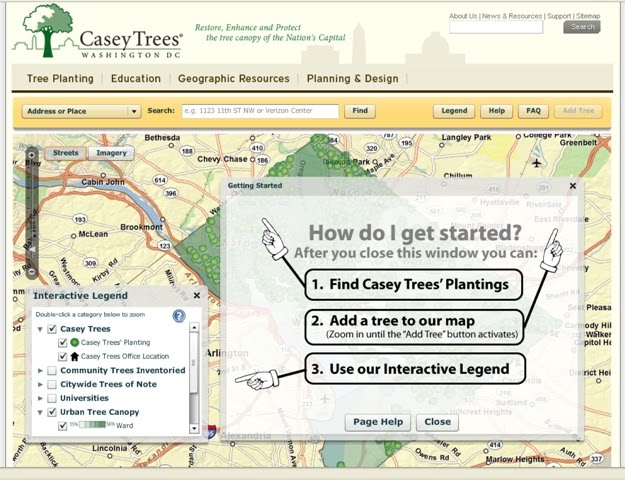
  • To start, go to www.caseytrees.org. The Casey Trees Map is found under Geographic Resources -> Interactive Maps.
  • Simply hit the ENTER button on the opening screen. The second screen provides you with basic prompts including a PAGE HELP button. When you are ready, hit the CLOSE button.
  • To nominate or add a new tree zoom in on the map using your mouse or the zoom tool in the left corner until the button at the top right of the map labeled ADD TREE fills in.
  • Go ahead and click it. Next choose what type of tree you want to add. The button on the left is for trees you have planted, the one on the right is for the Trees of Note program.
  • Scroll on the map to the approximate location you believe the tree is locate and click your mouse. A short form asking you a few questions about the tree will pop up immediately.
  • Fill out the form to the best of your knowledge. If you do not know the genus or species, you may select OTHER from the drop down bar. You may also add a photo. The more information you provide the easier the tree will be to find and confirm.
  • You're done!
What happens after you take the time to add a tree to the Casey Trees Map? A Casey Trees Citizen Verifier will visit the tree and confirm the information submitted. If the nominated tree is on private property the Citizen Verifier will arrange a time that is convenient for you to come out.

The District is much more than bricks and mortar. We hope the Casey Trees Map and Trees of Note program better connects you to the City’s trees, encourages you to visit the neighborhoods these trees are in and gets you to help protect and care for existing trees so we may have more Trees of Note in the future.

Friday, July 24, 2009

WHAT ARE YOUR TREES WORTH?

Utility bills costing you too much?

Planting trees strategically in your yard can result in some serious home cooling and heating savings. What would you do with extra cash - take a vacation, go shopping, get a mani/pedi, buy me a nice gift?


The August issue of Better Homes and Gardens not only sings the praises of planting trees but highlights Casey Trees and Davey Trees' Tree Benefit Calculator which allows anyone to estimate the economic and ecological benefits of planting trees in their own yard.

With the help of the Tree Benefit Calculator you can know the value of your trees and finally have that perfect ice breaker to use at parties. I imagine it could go something like..."Hey there. My trees add $200 to my property value and help to conserve 31 kilowatts of energy. What is your name?"

The good news is if the ice breaker falls flat you will still know how much your trees are helping to pay the bills.

Check out the Tree Benefit Calculator and other useful online tools such as Casey Trees Map and the Carbon Offset Calculator at www.caseytrees.org.

Monday, May 4, 2009

NEW ONLINE TOOL - CASEY TREES MAP

Have you checked out the new Casey Trees Map yet? If not, brace yourself, it's pretty amazing.

The roll out of the Casey Trees Map accompanied the announcement of Casey Trees Urban Tree Canopy (UTC) Goal of 40 percent by 2035 and features two interfaces - DC UTC and Casey Trees Tree Planting Maps.

The DC UTC Map allows individuals to determine the existing tree canopy and planting opportunities for any property or place in DC. The sample search above shows that while the majority of the property would not support any trees due to imperviousness (i.e. house blueprint, driveway, etc.), 28 percent would. By determining your property's planting potential, you can better identify how you can easily play role in re-greening your home, neighborhood and city.

The Casey Trees Tree Planting Map allows users to locate all 5,567 trees (and counting) Casey Trees has planted since 2003. You can search by address or place, tree species, and/or event planting name.

So give the Casey Trees Map a whirl and let us know what you think.

To learn more about the UTG Goal - 40 percent by 2035 - click here.