Showing posts with label Trees of Note. Show all posts

Thursday, January 20, 2011

Notable American Elms

Contributing Writer - Carol Herwig, Volunteer Coordinator

Although Dutch elm disease (DED) has diminished many of Washington D.C.'s elm-lined streets and parks, there are a few grand survivors that can be appreciated. Some, such as the grand Lafayette Park elm facing the White House at Madison Street NW and those on the National Mall, receive special attention from the National Park Service. Elm lovers in Mount Pleasant raise money to inoculate their old trees against DED.

A massive American Elm at the southeast
corner of Lafayette Park.

The American elm towering over the Metro bus stop at Sherman Circle and Crittenden Street NW has a diameter at breast height (DBH) of 5 feet (15.5 feet in circumference) and a crown spread of 90 to 100 feet. Its future is threatened – a lower limb was torn off in last winter's windstorm, leaving a large wound. Rock Creek Cemetery boasts an elm with a DBH of 45 inches and a hundred-foot spread that shades New Hampshire Avenue NW.

The biggest elm in Ward 1, on Ontario Place NW, is nearly five feet in diameter. In Capitol Hill, south of the Capitol off 3rd Street, are some great elms. North Carolina Avenue SE has an mix of survivors and the selections arborists have turned to as replacements: Japanese zelkovas, Chinese elms and more recently, disease-resistant 'Princeton' cultivar American Elms planted by Casey Trees.

The long-lived John Quincy Adams Elm in 1965.

Sadly there are many great American Elms that have not survived. An elm on the southeast grounds of the White House, known as the John Quincy Adams Elm, lived from 1826 to 1991 when it was taken down because of structural concerns. A sapling was derived from a root cutting from the original tree and was planted in 1991 by First Lady Barbara Bush, so in a way the ancient tree lives on.

There are also many notable American Elms outside of the District. The national champion elm, according to American Forests' Big Tree survey, is in Ross County, Ohio. It has a circumference of 273 inches (DBH of just over 7 feet), stands 118 feet tall and has a crown width of 100 feet. American Forests, in selecting Big Trees, follows the following formula to determine the Big Tree champion for each species: Trunk Circumference (DBHx3.1416 or pi) + Height + ¼ Average Crown Spread = Total Points. Using those standards, the Sherman Circle tree's formula is 186 inches + 55 (feet) + 25 (feet) = 266. The Ohio tree received 416 points.
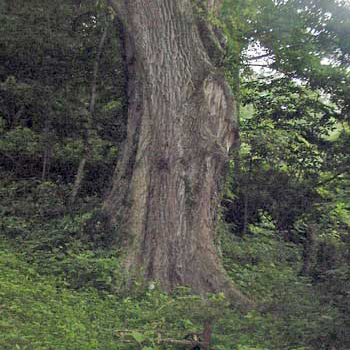
The national champion elm in Ross County, Ohio.

You can view notable American Elms on the Casey Trees Map. You can even nominate a favorite elm in your neighborhood if it has not yet been selected or look at historic American Elm corridors throughout the District.

Thursday, April 29, 2010

TREE OF NOTE - CONNECTICUT AVE PIN OAK

Contributing Writer - Mark Buscaino, Executive Director
Ongoing Series - Trees of Note


This Pin oak (Quercus palustris), located at the corner of Connecticut Avenue and Windom Place NW, is an incredible tree. Standing 65’ tall, 43” in diameter, it is truly an urban “arbor warrior.The area surrounding this tree completely paved or encased in concrete (with the exception of some garden beds across the street). Why it continues not just to survive, but remain in reasonable condition, is a biological miracle.


I’m sure you know of a tree like this – the one in the playground with nothing but asphalt completely surrounding it, the massive street tree with roots pouring over the curb into the street, the tulip poplar bent like a pretzel around a fence – there are many examples of survivors throughout the District, denying the facts of tree biology and common sense.

I love these trees best because they serve as sentinels of the past and hope for the future.This city was designed to support trees but population pressures hav
e and will continue to assault that principle of urban design.

But no matter how strong urbanization’s pressures bear down on these trees with asphalt, new construction, power lines, street car lines and other infrastructure which compromise their health, these trees refuse to bend, they refuse to die.
There’s power in these trees that transcend their beauty – they are in many ways emblematic of the thousands of volunteers at Casey Trees who every year plant trees, care for trees, and spread the word of the benefits of trees to all corners of the District.

We need more sentinels – both trees and people, to continue the fight so Washington DC will remain The City of Trees.
If we do not, trees like my favorite Pin oak, which will eventually die and be removed, will never be replaced – and worse yet will be forgotten.

Our task is simple – never forget – never give up – continue the fight and continue to plant and advocate for trees in DC’s neighborhoods, parks, streets, and in unlikely places as well – places like this pin oak found 100 years ago, and still reminds us of its struggle today.

Visit this Tree of Note!
Connecticut Avenue and Windom Place NW
Washington DC

All Trees of Note can be found on the Casey Trees Map.
__________________________________________________

Pin oak 101:


  • Location - native to eastern North America, mainly in the eastern United States from Connecticut west to eastern Kansas, and south to Georgia across to eastern Oklahoma.
  • Crown - pyramidal; 25 - 40' spread
  • Height - 60 -70'
  • Foliage - deciduous; alternate; simple; 4 - 8" long blade
  • Color - dark green leaves in spring/summer; russet, bronze or gold in fall
  • Flower - brown, faded color; blooms in April/May
  • Fruit - round; 1/2" long; features saucer-like cup of small, tight scales
  • Bark - thin; furrowed
  • Landscape use -great street tree; shade
_____________________________________________

Nominate a Tree of Note! All individuals that nominate a Tree of Note by Arbor Day on Friday, April 30, 2010 will be entered to win a signed copy of City of Trees by Melanie Choukas-Bradley. All Trees of Note can be found on the Casey Trees Map.

Monday, April 26, 2010

TREE OF NOTE - DUMBARTON OAKS BEECH TREE

Contributing Writer - Maisie Hughes
Ongoing Series - Trees of Note

If you have ever spent time in Dumbarton Oaks' gardens you know what it feels like to be surrounded by beautiful trees. This well-kept, historic landscape is the only place I go to see the cherry blossoms because I can avoid the crowds and enjoy the many other stunning trees just awakening from their winter slumber.

Among these natural treasures is a American Beech (Fagus grandifolia) that stands in the middle of its own outdoor room appropriately named the Beech Terrace.


While not the original beech tree the terrace was designed around in the 1920's - the original, a Riversii, was removed in 1948 after a period of decline - this American Beech has flourished in its surroundings and certainly makes Dumbarton Oaks a year round destination.

At 49.5 inches in diameter at breast height, its canopy spans the terrace. It has a smooth, light gray bark and long pointed buds, and when in leaf, makes the dappled sunlight dance across the ground. The exposed shallow roots are simply amazing. They rise above the ground, overlapping each other, creating a textured, lacelike pattern.

The only thing more compelling than the beauty of this American beech is the sense of place you get when you are nestled under its canopy. Because the tree was planted in the center of the terrace, its branches create a living ceiling that changes with the seasons. No matter the time of year, this tree hugs you back.

Visit this Tree of Note!
Dumbarton Oaks
31st and R Streets NW - garden entrance
Washington DC
______________________________________________________

Beech Tree 101:


  • Location - native to eastern North America from Nova Scotia to southern Ontario, west to Wisconsin, south to northern Florida and eastern Texas
  • Crown - wide spreading oval
  • Height - 50-70' with a maximum height of 120'
  • Foliage - deciduous;
  • Color - silvery green when opening; dark green in summer; golden bronze in fall; leaves can remain into winter
  • Flower - yellow-green flowers; blooms between April and May
  • Fruit - irregularly triangle shaped nut; shiny brown; edible; found in pairs in a woody husk covered in spines
  • Bark - thin; silver-gray; can be compared to elephant skin
  • Landscape use - shade tree; ideal for large spaces
______________________________________________________

Nominate a Tree of Note! All individuals that nominate a Tree of Note by Arbor Day on Friday, April 30, 2010 will be entered to win a signed copy of City of Trees by Melanie Choukas-Bradley. All Trees of Note can be found on the Casey Trees Map.

Thursday, April 22, 2010

TREE OF NOTE - RENO ROAD DAWN REDWOOD

Contributing Writer - Catherine Handren Communications Associate
Ongoing Series - Trees of Note

On a recent outing to take photographs of Big Tree nominees, I was surprised to see a dawn redwood (metasequoia) on the list. A native to the Szechuan and Hupeh providences of China, I had assumed - incorrectly - that all the dawn redwoods in the U.S. were located on the west coast.

What first struck me about this dawn redwood was its sheer size and expansive root system, partially visible at the base of the tree. Located in a relatively small backyard, the tree takes up almost all the available space. The other standout characteristic is the color of its bark - a stunning red.


The dawn redwood, a deciduous conifer, looks like something from a pre-historic forest. The unusual bark, enormous size and almost fern-like needles are unlike anything I have ever seen. It just so happens, the dawn redwood dates back to over fifty-million years ago and until 1941, the only evidence of the tree’s existence was in fossilized form. Two years after the discovery of a living dawn redwood in China, young saplings were brought to the U.S. National Arboretum.

While you cannot freely visit this dawn redwood on Reno Road, you can see others in their full glory at the Arboretum on the lower slope of Mount Hamilton.

________________________________________________

Dawn Redwood 101:

  • Location - Native to Szechuan and Hupeh provinces in China.
  • Crown - Pyramidal with ascending branches. Grows somewhat rounder with age.
  • Height - Although the shortest of the redwoods, it grows to at least 200'.
  • Flower - Winter buds; small, pale.
  • Foliage - Deciduous; thin and flat; flowing needles 1/2"-1 1/2" long.
  • Color - Soft green; bright orange-brown in autumn.
  • Cones - Round or cylindrical; green when young, brown when mature; 1/2"-1" long
  • Bark - Reddish brown or grayish brown; cracked and peeling in strips.
  • Landscape use - Ideal for modern landscape plantings.
_________________________________________________

Nominate a Tree of Note!
All individuals that nominate a Tree of Note by Arbor Day on Friday, April 30, 2010 will be entered to win a signed copy of City of Trees by Melanie Choukas-Bradley. All Trees of Note can be found on the Casey Trees Map.

Wednesday, April 21, 2010

TREE OF NOTE - ATLAS DISTRICT RED MAPLE

Contributing Writer - Lacey Brown, Education Coordinator
Ongoing Series - Trees of Note


This is the Red maple (acer rubrum) that lives in front of my new house. It’s a young, spindly thing - in all ways nondescript, not really at all impressive. However, it’s my favorite tree in DC simply because of the potential it represents.

When my husband and I were house hunting we fell in love with the neighborhoods adorned by graceful old trees soaring over the houses, casting their shade on the streets, yards and sidewalks below. The trees created neighborhoods where I found the people a little more friendly and more likely to exchange smiles and hellos with passerbys. How could you not be pleasant when in such an inviting streetscape?

While we don't live on one of these picturesque tree-lined streets, the trees we do have are full of promise and diversity. There are very old, tall trees with large canopies and gnarled root structures toppling out of their too small tree boxes. We have medium size trees that provide an ample amount of greenery and shade. And there are empty tree boxes anxiously awaiting their new occupants.

Then there is My Tree, the red maple in front of my house, just a couple of years old, brand new to the street just like we are. My Tree will grow as we grow in our new home.

By the time we add a new porch, our tree will be big enough to help shade it, creating a cool, outdoor space from where can greet our neighbors. When we are ready to add interior shutters to the windows, its branches will have grown even more and shade the rooms from the sun, lowering our utility costs. As plumbing issues pop up, we can rest assured that is root structure will have developed enough to help mitigate heavy rains. And if we decide to sell our home, I know my tree will increase its curb appeal and resell value.

Without question, we must appreciate and protect the mature trees that line our streets and dot our parks but we must be sure to appreciate and care for our young trees, like my red maple, to ensure that we will always be able to live, work and play beneath towering, green archways.

Visit this Tree of Note!
13th and F NE
Washington, DC

See all the Trees of Note on the Casey Trees Map.
_________________________________________

Red Maple 101:
  • Location - native to eastern North America; one of the most common deciduous trees.
  • Crown - oval shape.
  • Height - 40'-60' tall.
  • Foliage - 2"-4" long, opposite, simple
  • Color - green above, whitened beneath; turns bright red and yellow in fall.
  • Flower - small, hang in clusters, usually bright red; appear in spring before leaves.
  • Fruit - clusters of 1/4"-3/4" long samaras with slightly divergent wings; light brown; ripen in late spring, early summer.
  • Bark - on young trees, smooth and light gray, with age becomes darker and breaks up into long, fine, scaly plates,
  • Landscape use - excellent shade and street tree, good choice for urban areas with ample room for its root structure.

Nominate a Tree of Note! All individuals that nominate a Tree of Note by Arbor Day on Friday, April 30, 2010 will be entered to win a signed copy of City of Trees by Melanie Choukas-Bradley. All Trees of Note can be found on the Casey Trees Map.

Monday, April 19, 2010

TREE OF NOTE - HOSTELLING INTL EASTERN REDBUDS

Contributing Writer - Sue Erhardt, Director of Education
Ongoing Series - Trees of Note

I would like to share with you two Trees of Note I am thankful to have in my life - Eastern redbuds (Cercis Canadensis) located at the entrance of Hostelling International in downtown DC.


For almost two years I have walked past these Eastern redbuds on my way into and out of the office
. Without exaggerating, I have easily walked by these trees more than a thousand times and each time I do their presence still makes me smile.

These Eastern redbuds trees have also become my marker for the seasons. Right now the trees are adorned with brilliant, delicate lavender buds signaling the arrival of spring and warmer weather. The heart-shaped, green leaves hint that summer is just ahead and when fall arrives, these same leaves will turn bright yellow and rain down on me when the wind blows. And of course, winter is announced when the trees go completely bare.

Now a word of caution. This past holiday season, someone wrapped holiday lights up and down the trunks of both trees and then left them up even after Santa had come and gone. I'll be the first to admit that as a daughter of a woman who makes Chevy Chase in National Lampoon's Christmas Vacation look like an amateur, I love holiday decorations. Unfortunately the lights were wrapped so tightly around both trunks that they were girdling the trees.

What is girdling you ask? Girdling refers to any activity injuring the bark of a tree trunk and extends around much of the trunk's circumference. Such injuries can destroy the tree's most vital membranes which are responsible for transporting nutrients up and down the tree. If too severely damaged, the tree will die.

In early February the lights finally came down but as you can see in the picture below, scarring was left behind. These trees are a testament to how tough city trees need to be to survive.


My parting thought is that the life of a city tree is not easy and these two trees have endured. If only these trees could talk, I wonder what they would say.


Visit this Tree of Note!
Hostelling International Washington, DC
1009 11th Street NW
Washington, DC

See all the Trees of Note on the Casey Trees Map.
________________________________________________

Redbud 101:
  • Location - The range is from New Jersey and southern Pennsylvania northwest to southern Michigan, southwest into southeastern Nebraska, south to central Texas and east to central Florida. A distinct population extends from Trans-Pecos and south Texas into Mexico.
  • Crown - round; vase shape
  • Height - 20-30'
  • Foliage - 4-8" long simple; alternate
  • Color - green in spring/summer; yellow in fall
  • Flowers -Pink to reddish purple, rarely white; bloom in early spring.
  • Fruit - 1-3" pod; does not attract wildlife; no litter problem
  • Bark - thin; easily damaged from mechanical impact
  • Landscape Use - attractive choice for understory or specimen planting; commercial and residential landscapes
_________________________________________________

Nominate a Tree of Note! All individuals that nominate a Tree of Note by Arbor Day on Friday, April 30, 2010 will be entered to win a signed copy of City of Trees by Melanie Choukas-Bradley. All Trees of Note can be found on the Casey Trees Map.

Thursday, April 15, 2010

TREE OF NOTE - ROCK CREEK CEMETERY BLACKGUM

Contributing Writer - Carol Herwig, Volunteer Coordinator
Ongoing Series - Trees of Note


When asked to pick my favorite tree, I can be fickle. A majestic white oak at the Franciscan Monastery draws me in the winter. In the summer, nothing’s cooler than the cedar in Grant Circle. But I always come back to the blackgum (Nyssa sylvatica) — my blackgum — at Rock Creek Cemetery’s oak grove.


In early April, the leaves are small, Granny Smith apple green, and very shiny. By early summer, they’ll be glossy and dark green. The flowers, in green clusters, are demure, easy to miss. Tree id books claim that the fruit is blue and berry-like. I’ve never seen them.

My
blackgum is tall – easily 50 feet. It stands up to the big 100-year-old white oaks and hickories that frame it with a slightly weeping format. The trunk is lean, but the bark is dark, almost black and chunky, hence the common names blackgum and black tupelo.

In late August, early September, my
blackgum debuts an elegant display of lipstick-red leaves. It starts with just a tip of red on a leaf or two, as if the tree misread the weather.

There are many trees native to this area that have outstanding fall color:
sweetgum, serviceberry, oxydendron, even the pear. But nothing offers the pure red of this blackgum. Think Ferrari red. Red shoes red.

And then it’s gone, leaving me to anticipate its return in the spring.


Visit this Tree of Note!

Rock Creek Cemetery
Rock Creek Church Road and Webster Street NW
Washington, DC

See all the Trees of Note on the Casey Trees Map.
_______________________________________________

Blackgum 101:
  • Alt names - Sourgum, black tupelo
  • Location - native to North America
  • Crown - oval, pyramidal
  • Height - 65-75'
  • Foliage - 4-8" in length, elliptic, alternate, simple.
  • Color - green in spring/summer; orange and red in the fall
  • Flowers - white, inconspicuous; spring flowering
  • Fruit - oval, round; blue
  • Bark- dark, chunky
  • Landscape Use - shade tree, street tree, parking lot islands, wide tree lawns, median strips
_______________________________________________

Nominate a Tree of Note! All individuals that nominate a Tree of Note by Arbor Day on Friday, April 30, 2010 will be entered to win a signed copy of City of Trees by Melanie Choukas-Bradley. All Trees of Note can be found on the Casey Trees Map.

Wednesday, April 14, 2010

TREE OF NOTE - COMMEMORATIVE TREES

Contributing Writer - Mike Alonzo, GIS Specialist
Ongoing Series - Trees of Note


As a tree grows, its character is shaped by several factors including the nursery that grew it, soil and weather conditions and of course who planted it.

While how a tree is planted and the skill level of the individual who planted the tree play important roles, so does the long term relationship between the tree and planter and the reason why the tree was planted. At Casey Trees, individuals, groups or companies can sponsor tree plantings to commemorate events or loved ones, and volunteers who help plant at our Community Tree Planting events can also help name their trees.


Sponsoring the planting of one or several trees not only helps restore the District's tree canopy but also serves as a thoughtful and lasting legacy to a person or event that has occurred in the lives of families, friends or individuals. No reason is too small or silly. These commemorative trees are all Trees of Note because they represent are special to someone.


For example.


“Max the Dog” passed in early 2009. “Rudy the Dachshund” passed in the spring of 2008. “Casey the Dachshund” passed in the fall of 2009. These fine gentlemen and beloved pets now live on as a Chinese Pistache, a Sweetgum and a Swamp White Oak respectively. You can find them in Northwest’s Reno Park and Newark Community Garden.


Tree plantings are also used to commemorate life. Some cultures and individuals (most famously, Matthew McConaughey) have a tradition where they include the placenta of a newborn baby when planting a fruit tree. The placenta nourishes the tree and is considered a gift back to the earth. This spring we planted our first placenta at the Developing Families Center in Northeast DC. It wasn’t with a fruit tree but the “Placental tree” Redbud next to the center’s garden is equipped to thrive. Don't worry - you can plant a tree to commemorate a birth sans placenta!


Some individuals give names to trees at our Community Tree Planting events just because it is fun. Volunteers named a Chinese Elm "Brad Pitt" in Mount Vernon and local university students named their Japanese Lilac “Angelina Jolie”. Interestingly, the students responsible for planting "Angelina Jolie" also planted an American Hornbeam they believed bore a close resemblance to hockey legend Mario Lemieux. I bet each of these individuals check in on Brad and Angela regularly.


And then there are the inexplicable but just as important to those that named them. Two Sweetgums and a Red Oak in the North of Mass Ave Business Improvement District are dedicated to (or named after?) “Squirrel”. Who is squirrel? We don’t know. One Serviceberry at the Developing Families Center memorializes “Divine Science”.


As you can see, the gravity of the occasion need not matter – a tree can be deemed special by anyone who plants it, cares for it, or simply enjoys its shade. We at Casey Trees encourage you to add your own Tree of Note along with their significant dedications or whimsical names to the Casey Trees Map.


Visit the Tree of Note pictured above!
St. Paul's Rock Creek Episcopal Church
Rock Creek Church Road and Webster Street NW

Deodar cedar Planted by the Zoroastrian Association of Metropolitan Washington

Sponsor a
Commemorative Tree planting!
Choose a public or private dedication to commemorate a person, loved one, or event important to you.

___________________________________________________

Nominate a Tree of Note! All individuals that nominate a Tree of Note by Arbor Day on Friday, April 30, 2010 will be entered to win a signed copy of City of Trees by Melanie Choukas-Bradley. All Trees of Note can be found on the Casey Trees Map.

Tuesday, April 13, 2010

TREE OF NOTE - AFRH OSAGE ORANGE

Contributing Writer - Jared Powell, Director of Communications
Ongoing Series - Trees of Note


I came across this Osage orange (Maclura Pomifera) on the grounds of the Armed Forces Retirement Home (AFRH) during Casey Trees' Arborists' Day of Service and immediately knew it was "the one". Reasons being - it is a little awkward, needs a little help (it's trunk is being supported by a pole) and its fruit smells similar to oranges. Two of those three items reminded me of myself. I'll let you guess which two.

What also stands out about this Osage orange is its potential historical significance. Arborists familiar with the site say that President Abraham Lincoln is purported to have reclined in the crook of the tree while drafting the Emancipation Proclamation. You see, President Lincoln and his family resided here from June to November of 1862, 1863 and 1864 so it is more than possible that he popped outside the cottage to write in the shade of the tree. That tree screams "recline in me but still love me and be kind to me".

Not only is my Osage orange a great nominee for the My Tree category but it is in the running to be a Witness Tree. Of course we are in the process of verifying what this tree may have actually seen.


I encourage you all to visit the restored President Lincoln's Cottage in NW and while you are there, check out the Osage orange and the fine tree care that arborists performed during the Day of Service next to Stanley Chapel.
_______________________________________________________

Osage orange 101:

  • Location - occurs naturally in the Red River drainage of Texas, Arkansas and Oklahoma and in the Blackland Prairies, Post Oak Savannas and Chisco Mountains of Texas; widely planted throughout the United States and Canada
  • Crown - round, spreading
  • Height - 40-6' with a short trunk
  • Foliage - large, 3-6" long, alternate
  • Color - dark green; turns bright yellow in fall before dropping
  • Flowers - white, inconspicuous; spring flowering
  • Fruit - pale green globes, 4-5" diameter, filled with milky, latex-based juice; inedible for the most part
  • Bark - dark, deep furrows, scaly
  • Landscape Use - windbreaks, hedges
___________________________________________________

Nominate a Tree of Note! All individuals that nominate a Tree of Note by Arbor Day on Friday, April 30, 2010 will be entered to win a signed copy of City of Trees by Melanie Choukas-Bradley. All Trees of Note can be found on the Casey Trees Map.

Thursday, April 8, 2010

TREE OF NOTE - 16TH STREET TULIP POPLAR

Contributing Writer - Holli Howard, Director of Geographic Resources
Ongoing Series - Trees of Note


The front yard of my building faces 16th Street NW and is one of the many ‘public parking’ spaces on this main thoroughfare fortunate enough to have a large tulip poplar (Liriodendron tulipifera) in it.

What makes the tulip poplar in my front yard interesting is that it was originally a street tree and was planted in the 1870's by the Department of Public Works under the District's second and last Governor, Alexander Shepherd.


In 1993, the National Park Service produced the Historic American Buildings Survey of Sixteenth Street, and found that a scheme of tulip poplars were planted the entire length of 16th Street.
"After the territorial government fell in 1874, its responsibilities were turned over to a board of commissioners, which published a map in 1880 showing street-tree species throughout the city. The map indicates that Sixteenth Street was lined with poplars; today's Sixteenth Street still has evidence of these poplars, but instead of being planted in the strips between the sidewalk and roadway, the several old specimens that remain are planted between the sidewalk and the building lines within the front yards of the facing residences. The trees appear to predate many of the homes built along the road, which feature fences and front walks consciously diverted around their trunks."
While the tulip poplar in my yard is not the largest in the City, its history makes it worthy of being my Tree of Note. I encourage you to drive along 16th Street to enjoy all the tulip poplars that line the length of it and then visit the District's largest one located in Georgetown's Montrose Park (61" diameter).


I also admire the tulip poplar for providing great environmental benefits for the City.

In 2009, Casey Trees completed its second iTree Eco Inventory based on the Urban Forest Effects Model. According to the results produced by Dr. Dave Nowak's team at the Forest Service Northern Research Station, the tulip poplar is the third most prevalent tree species in DC and has the highest percent leaf area. Because leaf area equates directly to the benefits a tree provides, the tulip poplar is the second highest in Importance Value. Additionally, the tulip poplar stores approximately 15 percent of the total carbon stored in Washington and 11 percent of the total sequestered carbon.


I was also able to calculate the economic benefits of the tulip poplar tree in front of my building. Using the Tree Benefits Calculator on the Casey Trees website, I determined that we receive $178 in benefits annually. Not too bad.

___________________________________________________

Tulip Poplar 101:

Location - eastern and southeast portions of the United States
Crown - narrow, oval
Height - 80' - 100'
Foliage - 6" long and wide, alternate and heart-shaped
Color - bright green leaves that turn a butter yellow in fall
Flowers - pale green, yellow flowers beginning in April
Bark - smooth, light ashy-gray with shallow longitudinal, whitish furrows when young; thick, interlacing furrows and rounded ridges with age
Landscape uses - desirable street or shade tree
___________________________________________________

Nominate a Tree of Note! All individuals that nominate a Tree of Note by Arbor Day on Friday, April 30, 2010 will be entered to win a signed copy of City of Trees by Melanie Choukas-Bradley. All Trees of Note can be found on the Casey Trees Map.

Tuesday, April 6, 2010

TREE OF NOTE - MCPHERSON SQUARE RED OAK

Contributing Writer - Mike Galvin, Deputy Director
Ongoing Series - Trees of Note


A tree so big that it provides shade even when it has no leaves - that is worth saving!

The red oak (Quercus rubra), featured above, is located in downtown DC in McPherson Square. I took this photo in mid-March, too early for any leaves to be on the tree but perfectly timed to coincide with beautiful weather – temperatures in the 60’s. Just before I took this shot a man was relaxing in the shade of the tree. This tree is so huge it casts a great deal of shade even without any leaves. It is 60” in diameter – that’s almost 16’ around the trunk - and 115’ tall. It provides a great place to have an outdoor lunch and get respite from the heat of the day beneath its cool canopy.


I am not sure how old this red oak is but it is most likely not an original element of McPherson Square. Built in 1867, McPherson Square was originally named Scott Square as a memorial to Lieutenant General Winfield Scott. Five years later the statue of Scott was moved to the circle at Massachusetts and Rhode Island Avenues, and the square was planted with silver maples lining the perimeter, graded and sodded. In 1876 the statue of James B. McPherson, a Major General in the Union Army who fought in the American Civil War, was installed and the square was renamed McPherson Square.

In 1892, the Army Corps of Engineers completely redesigned the park. The entire grade was elevated and twenty-one existing trees were removed. This indicates that the tree was probably planted sometime in the late 19th or early 20th century and is approximately 100 years old today. A plant list circa 1905 lists two red oaks on the site – this tree could well have been one of them.


The National Park Service is again planning improvements to McPherson Square. The work is being planned in such a way so that this tree will be retained.

Visit this Tree of Note - McPherson Square, 1400 I Street NW, Washington DC 20050.
This red oak is also listed as a Trees of Note on the Casey Trees Map.

_________________________________________________________

Red Oak 101:
  • Location - common to the East Coast and Midwest
  • Crown - rounded
  • Foliage - leaf is 4"-8" long, bristle tips on lobes
  • Color - reddish in spring, dark green in summer, russet in fall
  • Fruit - acorn has a saucer-like cap, takes two years to mature
  • Bark - steel gray, ridged and furrowed
  • Landscape use - great street tree; tolerant of urban pollution
_________________________________________________________

Nominate a Tree of Note. All individuals that nominate a Tree of Note by Arbor Day on Friday, April 30, 2010 will be entered to win an autographed copy of City of Trees authored by Melanie Choukas-Bradley.

Monday, April 5, 2010

WHERE IS YOUR FAVORITE TREE?


April is a big month for environmentally focused organizations. We've got Earth Day on Friday, April 22 and National Arbor Day closing out the month on the 30th. As you can imagine, Casey Trees is especially sweet on Arbor Day. My friend likens the entire month to being our Fashion Week. I kinda like that comparison.

Arbor Day did not start off small like other movements. In 1872, J. Sterling Morton proposed to the Nebraska Board of Agriculture that a special day be set aside for the planting of trees. The first holiday was observed with the planting of one million trees in Nebraska. For over 135 years, governments, organizations, businesses and individuals have kept this tradition alive by adding to the tree canopy in their communities on National Arbor Day and on different dates adopted by individual states to coincide with that area's best tree-planting times.


In the District, Casey Trees is one of several organizations that adds to the City's tree canopy - with the help of countless volunteers - not just on Arbor Day but throughout the year. One way that Casey Trees encourages people to add and care for trees in the District is by helping them to remember that some of our most special memories revolve around trees.


We climb them as kids, steal kisses and picnic under their shade, get married under them, plant them to commemorate births, graduations and the passing of loved ones, smile when they bloom, watch birds nest in and squirrels scurry up them, and hide under them when a storm sneaks up on us.

These special memories are exactly why we created the Trees of Note program, an interactive feature of the Casey Trees Map that helps connect people to trees in the District deemed special because of their size, history and/or personal significance. The category names for each are Big Trees, Witness Trees and My Trees respectively.

In the weeks leading up to Arbor Day, Casey Trees staff will be profiling trees located in the District that have personal meaning to them. The reasons may be simple or grand but no matter the basis it shows that each tree is significant to someone and deserves to be be cared for and protected.


I hope these stories will encourage you to add your own Trees of Note to the Casey Trees Map. You can share as little or as much about the tree as you can or know. You can also add a photo of the tree. Have fun with it.


By taking a few simple minutes to tell us about your favorite trees in DC you are helping to draw attention to and appreciation for our great natural resource in the City - our trees. Then when you have a spare weekend locate some Trees of Note on the Casey Trees Map and bike, walk, run or drive to them. Make a day of it. You will not only discover impressive trees but neighborhoods you have never ventured to before.


And for those that nominate a Tree of Note to the Casey Trees Map by this upcoming Arbor Day (Friday, April 30, 2010) you will be entered to win an autographed copy of the wonderful City of Trees book authored by Melanie Choukas-Bradley. Each nominated tree is an entry and there will be several winners so enter often.

**The featured picture is of a Black Walnut on Mount Pleasant Street nominated as a Big Tree.

Happy nominating and tree planting!

Thursday, December 24, 2009

Thursday, December 17, 2009

OH MY THAT IS A NOTEWORTHY TREE.


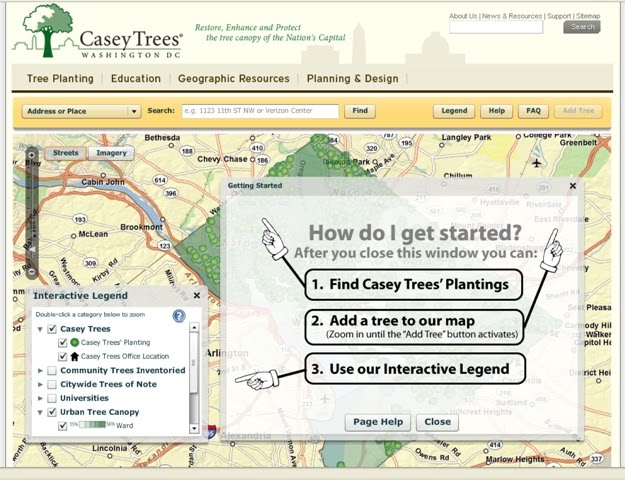
In April 2009, Casey Trees launched the Casey Trees Map, an interactive online tool to help users determine the existing Urban Tree Canopy (UTC) and planting opportunities for any address in the District and identify every tree Casey Trees has planted since 2003.

Just today in a soft launch we rolled out an enhanced version of Casey Trees Map featuring our new Trees of Note program and Add-A-Tree feature.


Trees of Note is a program that connects people to trees in the District deemed special because of their size, history and/or personal significance. Anyone can nominate or locate trees in three distinguished categories – Big Trees, Witness Trees and My Tree.


  • Big Trees are those valued for their sheer size and eligible for nomination to the National Register of Big Trees. The Register lists 826 species of trees. So far DC only has one Champion Tree, located on the U.S. Capitol grounds. Can you find another?
  • Witness Trees are trees present during a historical event or period. Frederick Douglass mentioned the White oak on his front lawn in his journal entries. Think of what that tree saw.
  • My Trees are those with personal meaning. This can be a tree you think has the prettiest blossoms in your neighborhood or even one you got married under. If it is special to you, we want to know about it.
Trees in DC are nominated to the Trees of Note program using the new Casey Trees Map point and click Add-a-Tree feature. The Add-A-Tree feature also allows you to add trees to the Casey Trees Map that you have recently planted in the District. Trees that you add to the map will count towards the City’s Urban Tree Canopy Goal of 40 percent by 2035.

In spring 2010, we will add a new tool that will allow you to update or delete a tree’s information in the event the tree has been removed or misidentified.


Nominating or adding a tree is easy to do own your own but I’ll walk you through the basic steps.


  • To start, go to www.caseytrees.org. The Casey Trees Map is found under Geographic Resources -> Interactive Maps.
  • Simply hit the ENTER button on the opening screen. The second screen provides you with basic prompts including a PAGE HELP button. When you are ready, hit the CLOSE button.
  • To nominate or add a new tree zoom in on the map using your mouse or the zoom tool in the left corner until the button at the top right of the map labeled ADD TREE fills in.
  • Go ahead and click it. Next choose what type of tree you want to add. The button on the left is for trees you have planted, the one on the right is for the Trees of Note program.
  • Scroll on the map to the approximate location you believe the tree is locate and click your mouse. A short form asking you a few questions about the tree will pop up immediately.
  • Fill out the form to the best of your knowledge. If you do not know the genus or species, you may select OTHER from the drop down bar. You may also add a photo. The more information you provide the easier the tree will be to find and confirm.
  • You're done!
What happens after you take the time to add a tree to the Casey Trees Map? A Casey Trees Citizen Verifier will visit the tree and confirm the information submitted. If the nominated tree is on private property the Citizen Verifier will arrange a time that is convenient for you to come out.

The District is much more than bricks and mortar. We hope the Casey Trees Map and Trees of Note program better connects you to the City’s trees, encourages you to visit the neighborhoods these trees are in and gets you to help protect and care for existing trees so we may have more Trees of Note in the future.