Thursday, January 20, 2011

Notable American Elms

Contributing Writer - Carol Herwig, Volunteer Coordinator

Although Dutch elm disease (DED) has diminished many of Washington D.C.'s elm-lined streets and parks, there are a few grand survivors that can be appreciated. Some, such as the grand Lafayette Park elm facing the White House at Madison Street NW and those on the National Mall, receive special attention from the National Park Service. Elm lovers in Mount Pleasant raise money to inoculate their old trees against DED.

A massive American Elm at the southeast
corner of Lafayette Park.

The American elm towering over the Metro bus stop at Sherman Circle and Crittenden Street NW has a diameter at breast height (DBH) of 5 feet (15.5 feet in circumference) and a crown spread of 90 to 100 feet. Its future is threatened – a lower limb was torn off in last winter's windstorm, leaving a large wound. Rock Creek Cemetery boasts an elm with a DBH of 45 inches and a hundred-foot spread that shades New Hampshire Avenue NW.

The biggest elm in Ward 1, on Ontario Place NW, is nearly five feet in diameter. In Capitol Hill, south of the Capitol off 3rd Street, are some great elms. North Carolina Avenue SE has an mix of survivors and the selections arborists have turned to as replacements: Japanese zelkovas, Chinese elms and more recently, disease-resistant 'Princeton' cultivar American Elms planted by Casey Trees.

The long-lived John Quincy Adams Elm in 1965.

Sadly there are many great American Elms that have not survived. An elm on the southeast grounds of the White House, known as the John Quincy Adams Elm, lived from 1826 to 1991 when it was taken down because of structural concerns. A sapling was derived from a root cutting from the original tree and was planted in 1991 by First Lady Barbara Bush, so in a way the ancient tree lives on.

There are also many notable American Elms outside of the District. The national champion elm, according to American Forests' Big Tree survey, is in Ross County, Ohio. It has a circumference of 273 inches (DBH of just over 7 feet), stands 118 feet tall and has a crown width of 100 feet. American Forests, in selecting Big Trees, follows the following formula to determine the Big Tree champion for each species: Trunk Circumference (DBHx3.1416 or pi) + Height + ¼ Average Crown Spread = Total Points. Using those standards, the Sherman Circle tree's formula is 186 inches + 55 (feet) + 25 (feet) = 266. The Ohio tree received 416 points.
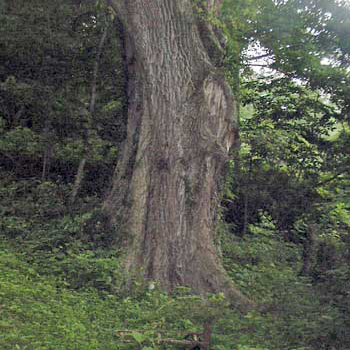
The national champion elm in Ross County, Ohio.

You can view notable American Elms on the Casey Trees Map. You can even nominate a favorite elm in your neighborhood if it has not yet been selected or look at historic American Elm corridors throughout the District.

Friday, January 14, 2011

Friday Photo Feature - January 14, 2011

American Elm leaves on the ground, Daingerfield Island.

Wednesday, January 12, 2011

How to Identify an American Elm

How do you know an American Elm when you see one? Here are some characteristics of American Elms that will help you identify these trees on the streets of DC.

Note the serrated edge and ovate shape of these emerging elm leaves.

Features of the American Elm:
  • Size: Can reach 100 feet tall or more, but generally mature city trees are 60 to 80 feet.
  • Trunk and branches: Vase-shaped with a canopy almost as wide as its height. Thick columnar trunk divides into large branches and then smaller branches that arch outwards. On classic elm-lined streets, mature elms often branch across the roadway.
  • Leaves: Alternating simple leaves that are ovate in shape. Doubly serrated with straight veins. Various sizes, but leaves usually are 3 to 6 inches long. Dark green in the summer. Notably, the base is asymmetrical (meaning one side of the leaf is broader than the other). Twigs and buds appear in striking zig-zag formation.
  • Fall appearance: Yellow or brown leaves.
  • Bark: When mature, dark gray-brown with deep, crossing ridges. Bark can be scaly when young.
  • Flowers: Tiny petal-less reddish flowers on pendulous stalks. Not showy. One of the first trees to flower, often in late winter before the leaves emerge.
  • Fruit: Small round, flat and papery-looking, with a notch at the apex. They are samaras, containing a single seed, and can be green or yellow.
If you're looking for American elms in the city, the obvious place to look is the National Mall where there are hundreds lining the walkways and surrounding the monuments. Additionally, at Lafayette Park and other sites near the White House there are many elms to see including mature specimens and the "Princeton" cultivar planted by Casey Trees along Pennsylvania Avenue. When Casey Trees inventoried the trees on the grounds of the Smithsonian Institution last year, we documented 165 American Elms, making it the Smithsonian’s most common tree species. Other locations include: New Hampshire Avenue NW (including Dupont Circle), North Carolina Avenue SE/NE and East Capitol Street in Capitol Hill, and Lamont and Park Streets NW in Mount Pleasant.

The vase-like spread of American Elms on the National Mall.

Learn more about our American Elm Restoration program on our website, including new planting locations for elms this winter.

Monday, January 10, 2011

Elm Pruning Workshop Recap

Contributing Writer - Carol Herwig, Volunteer Coordinator

Twenty Casey Trees Citizen Foresters, staff members and other volunteers joined National Park Service horticulturist Barry Stahl on Saturday, January 8, for a tree pruning workshop at Daingerfield Island. This wooded land just north of Alexandria doubles as a boat marina and tree nursery for the Mall. Stahl propagates elms from cuttings: at present, he’s growing the original American Elm species Ulmus americana, the disease-resistant cultivars Valley Forge, Princeton and New Harmony, plus the Jefferson and Washington elms.

Citizen Foresters work together to prune elms.
Our job was to prune up the young trees, generally 10-12 feet tall, nipping out dead and broken branches, removing too-low branches, establishing strong central leaders (that is, leading branches) and helping young trees get ready for their starring role on the Mall. This takes years and more than one pruning session. Casey Trees’ visit to Daingerfield Island has become a regular event on our winter calendar.

Stahl began the morning workshop with background on the various elms cultivars. The Jefferson and Washington cultivars have more rounded shapes than the others; the original Jefferson stands near the Freer and Sackler galleries and is distinctive for its rounded crown and because it greens up early and holds its leaves early; the newest elm in front of Natural History is a Jefferson, and the White House is getting a Washington. Stahl believes that there is no street tree quite like the American Elm and his passion and commitment to these trees comes through clearly.

Elms on Daingerfield island, nearly ready for planting in the District.
He explained there are no secrets to the Park Service’s Dutch elm disease maintenance plan. It is labor-intensive diligence with annual spring inspection and quick removal of diseased branches. Then we went to work, learning whys and hows of pruning. We prune in winter because the plant is dormant and so are the insects and diseases that can enter a tree through a pruning wound. Also, the tree’s structure is revealed. Conversely, late fall, when the sap is still running, is the worst time to prune.

Stahl teaches the three-part cut and the six steps of pruning. These include the five basics, plus one special one:
  1. Remove broken, diseased and dying branches.
  2. Select or create a central leader and cut back or remove competing branches.
  3. Select and establish the lowest permanent branch (depends on the tree’s location).
  4. Select scaffold branches and remove competing branches and plan for proper spacing
  5. Select temporary branches below the lowest permanent branch.
  6. Before you make a single cut, feel the ground, address the tree, walk around it and touch it.
With that, we went to work, bundling up with mufflers and handwarmers and armed with pruners, loppers and handsaws. We looked, we asked questions and we cut – carefully, thoughtfully.

Climbing a ladder to make a careful cut.
Warming up in the greenhouse afterward, we saw one- to three-year-old elms that are cared for indoors, to be planted outside when their time arrives. These young elms are closely cultivated, growing quickly, perhaps one day to stand among the magnificent trees on the National Mall.

Very young elms in the greenhouse.
View more pictures from the Tree Pruning Workshop on Facebook. We will be repeating the program on January 22 - please contact Carol Herwig if you are a Citizen Forester who would like to attend.

Friday, January 7, 2011

Friday Photo Feature - January 7, 2011

American Elms on the National Mall

Thursday, January 6, 2011

History of the American Elm in the District

Contributing Writer - Carol Herwig, Volunteer Coordinator

Lafayette Square in 1919. Photo by Martin Gruber.
Since Washington, DC’s origin as the nation’s capital, trees were a key element in the plan. George Washington (a noted plantsman) and planner Pierre L’Enfant envisioned tree-lined streets and parks. Thomas Jefferson bemoaned the loss of native groves, and followed up with a sketch and a planting of Lombardy poplars that, unfortunately, were spectacularly unsuited for Washington’s climate.

But the American elm, Ulmus americana, was already here, along with white pine and white oak and other native species. A mature elm can grow 60 to 80 feet tall with strong limbs creating a vase-shaped spread nearly equal to its height. The elm has an interlocking grain that is resistant to splitting, which made it valuable for wagon wheel hubs. Its wood is also resistant to rot in wet conditions.

So many of those big native elms were lost to the building of the city, cut down for timber. The Civil War further decimated Washington’s tree canopy, as most trees were felled to build the circle of forts that defended the capital.

The focus on Washington as a tree-lined city returned in the mid-1870s, post-Civil War, when Governor Alexander “Boss” Shepherd laid out his grand plan for the city: planting 60,000 trees, building sidewalks and installing curbs. Shepherd created a “parking commission,” a precursor to the District Department of Transportation, that was responsible for planting and maintaining the city’s trees. Shepherd’s term barely lasted two years, but the modern DDOT agency continues to be responsible for city trees though its Urban Forestry Administration.

Shepherd’s plan was the beginning of what we now know as the historic elm corridors. Streets were planted each with a single species, ignoring the risk of losing whole blocks to disease. This monoculture approach to tree planting only made the spread of Dutch elm disease easier when it arrived in the early 20th century and many elm-lined DC streets were decimated. Remnants can be found throughout the city: along South Carolina Avenue in the Southeast, to Branch Avenue east of the river,  to the state streets, New Hampshire, Arkansas, Kansas and Illinois, in the Northwest. Often diseased trees were replaced by Japanese zelkovas or Chinese elms and more recently by disease-resistant cultivars of the American Elm. But there are some grand survivors — at the southeast corner of Lafayette Park; along the western edge of Rock Creek Cemetery; on the Capitol Grounds; along the West Potomac Park waterfront and of course, on the National Mall.

Washington’s world-famous elms — the double allees on the Mall — are part of the McMillan Commission plan, influenced by Western Europe’s great avenues. Elms were chosen by the McMillan Commission because of the “architectural character of its columnar trunk and the delicate traceries formed by its wide-spreading branches.” Installation of the plan began in 1902 and was largely complete by 1922, after a pause for World War I.

Elms and the Lincoln Memorial in the snow.
The American Elm is a classic native tree of our city although it certainly has seen better days. At Casey Trees we are committed to maintaining and restoring the legacy of the American Elm as a street tree, which is why we have been planting over 1,750 elms in the city since 2003. Learn more about our American Elm Restoration program on our website.

Tuesday, January 4, 2011

Celebrating the American Elm

American Elms on the National Mall.
This January, we are celebrating the American Elm. This native tree is one of the oldest continuous residents of Washington, DC, and is a hardy street tree that provides shade and beauty for many neighborhoods in our city. As any District resident knows, or any visitor to the National Mall can see, elms are a defining part of DC’s status as the city of trees.

Winter 2011 should be a great season for elms – Casey Trees is planting 100 “Valley Forge” American Elms in Wards 1, 3, 5 and 6, in locations identified by the Urban Forestry Administration. Areas in which we are planting include Capitol Hill, Mount Pleasant, the Bladensburg Road NE corridor near the National Arboretum, and Nebraska Avenue NW near Tenleytown. You can view maps of the proposed planting locations on our website.

Throughout January we will share articles featuring the American Elm both past and present, and we will discuss our current planting efforts. You can keep up with us here by subscribing to our RSS feed, or by following us on Twitter or liking us on Facebook. We invite you to learn more about our American Elm Restoration program on our website, where you can find out where we are planting American Elms this year. You can also use the Casey Trees Map to explore the historic American Elm corridors, elms planted by Casey Trees, and learn about some of the elms featured as Trees of Note in our city.

Wednesday, December 29, 2010

Holiday Tree and Leaf Collection in the District

Wondering what to do with your tree and wreaths after the holidays? The Department of Public Works (DPW) has a solution for you as we head into the new year. From January 3 to 15, trees will be picked up at curbside.

What you need to know about holiday tree collection:
  • Remove all decorations and put your tree or other greenery in the treebox space.
  • Do not put your tree in plastic or cloth bags.
  • The prime time for collection is between January 2nd and 9th. January 9th is your deadline for leaving your tree for DPW to collect.
  • Any trees not collected by January 15th should be set out with your trash.
Still have a lot of leaves left over from this past fall? DPW will also pick up leaves raked into treebox spaces through January 15th. The DC government also provides great online resource that maps out the leaf collection schedule. DPW will be collecting between 8,000 and 10,000 tons of leaves between November and January, most of which will be composted or recycled.

DC's Leaf Collection schedule map for 2010-11.

For more information and guidelines, check out the DC Department of Public Works page on leaf and holiday tree collection.