Tuesday, January 19, 2010

TREE REFERENCE BOOKS

Casey Trees staff frequently gets asked what tree reference books we recommend. While we are not in the business of recommending books - Oprah Book Club we are not - I can share with you some titles that staff regularly consults. Their worn covers and dogeared pages are a testament to their usefulness.

In no particular order, here are some tree reference books you can peruse at your leisure or add to your wish list.

Manual of Woody Landscape Plants: Their Identification, Ornamental Characteristics, Culture, Propagation and Uses
.
Author - Michael Dirr
  • Color photographs showing a selection of trees at maturity make this a great book to consult when studying twigs and buds or when selecting a tree for your yard. However, the book size makes it too big to take on a hike.
Here are some suggestions that are easy to stuff into a bag:

Smithsonian Handbooks: Trees

Author - Allen J. Coombes.
  • Trees is divided into broadleaf and conifer, then subdivided into families. For example, oaks and beaches will be found together under Fagaceae. The photos include leaves, fruit, flowers and buds.
National Audubon Society: Field Guide to Trees, Eastern Region.
  • Trees are presented by type of leaf (simple, compound), with flowers and fruit color-keyed.
Peterson Field Guides: Eastern Trees
Authors - George Petrides and Janet Wehr
  • Color plates in the front illustrate buds, fruit, twigs, flowers and leaves. Text is in the rear.
City of Trees: The Complete Field Guide to the Trees of Washington DC
Author - Melanie Choukas-Bradley
  • Descriptions and photos of trees familiar to this area, plus historic and other places to see significant trees. Ms. Choukas-Bradley frequently leads tree tours for Casey Trees.
USDA: Field Guide to Native Oak Species of Eastern North America.
  • This handy guide is out of print but needs to be brought back. Detailed information about four dozen oaks, with drawings, leaf comparisons and detailed descriptions. Grab it if you can find it.
National Arbor Day Foundation: What Tree Is That.
  • This will allow you to key out a tree based on leaf or needle and buds. Good for young trees, hard to use in a more mature setting where buds are not at eye level.

Want a more substantive book?

The Urban Tree Book: An Uncommon Field Guide for City and Town

Author - Arthur Plotnik
  • Mr. Plotnik follows the alphabet, describing more than 200 urban trees. This is more of a narrative, with a little history or cultural information about trees ranging from tree of heaven to sweet gum to many oaks. A terrific book for browsing.
The Tree: A Natural History of What Trees Are, How They Live and Why They Matter
Author - Colin Tudge.
  • A little geology, a lot of botany and an enjoyable read by a research scientist. It will change your perception of what is a native tree.
Teaching the Trees: Lessons from the Forest
Author - Joan Maloof
  • Ms. Maloof lives on the Eastern Shore and writes about native trees we have taken for granted and are losing.

Thursday, January 14, 2010

NEVER TOO LATE FOR RESOLUTIONS


While we are already two weeks into the new year it is not too late to make resolutions for 2010. Actually the Chinese New Year is just approaching...

I always start my resolutions in February because the holidays are too busy to think about them and I never like to start my "get fit" routine among all the others who share that same goal. I find that a month in people have forgotten that pledge and I no longer have to do hand to hand combat for a machine. Not cruel, just strategic.


One resolution that is easy to make and keep is making DC a better place to live, work and play by helping the City become more green. Think trees. There are many ways you and your family can do it and Casey Trees can help you actually fulfill that resolution.


Here are a few ideas:

  • Plant a tree at home.

    Three great cost saving options for you:

    • RiverSmart Homes - Offered through DDOE, Casey Trees will plant a shade tree of your choosing from a pre-approved list on your property for $50.00 per tree. The number of trees is only limited to the available space.
    • Tree Rebate - Purchase and plant a tree at home and submit your receipt with the rebate form and receive up to $50 back per tree (up to 3 trees per property). This is a great option if you want to plant a tree on your own and/or the tree species is not available through RiverSmart Homes. No invasives or Ash trees allowed.
    • Treescape Design Workshop - Want to design a custom treescape plan for your home? Work with our landscape design professionals to create a plan that meets your goals such as introducing shade and/or seasonal color to your yard. Participants receive a free shade tree.
  • Volunteer.

    Planted out your own space and want to help others? Casey Trees offers year-round tree planting, tree care and tree inventory volunteer opportunities. Volunteering is a great way to meet new people, learn more about trees, visit different neighborhoods and advance our Urban Tree Canopy Goal of 40 percent by 2035.
  • Organize a Community Tree Planting (CTP).

    Identify ten or more locations for trees to be added and request a CTP. Casey Trees provides the trees, tools and technical assistance for free. We will even help you recruit volunteers. Requests for a fall 2010 planting must be in by June 15.

  • Help a neighborhood inventory their trees.

    Community Tree Inventories (CTI) help groups identify the condition, species, and location of their existing trees and plantable spaces. Following the inventory we provide the groups with an analysis of our findings and develop a strategy to meet their goals.

  • Nominate a Tree of Note.

    A new feature of the Casey Trees Map created to connect people to trees in the District deemed special because of their size, history and/or personal significance. Individuals can nominate a Big Tree, Witness Tree or My Tree and even add a tree they have recently planted to be counted towards the City's UTC Goal.

  • Become an advocate.

    Taking a Casey Trees class is the perfect way to become better informed about the District's urban forest and learn how you can encourage developers, elected officials, civic associations, etc. to protect and care for existing trees and add new ones. All our classes and programs are now free with the exception of the Tree Summit on March 25, 2010.

  • Tell a friend.

    Word of mouth is powerful. Telling a friend about Casey Trees and its programs is great. Forward this blog post, drop them an email or call them up. Even better is inviting one or two friends to an upcoming program, planting or class.
As you can see there are a number of ways Casey Trees can help you fulfill your resolution to make DC more green. So go ahead, be bold and get green with Casey Trees.

Thursday, December 24, 2009

Tuesday, December 22, 2009

REPORT TREE HARM

Have you walked by a tree getting the short end of stick? Be a friend to that tree and report it.

Trees in urban environments have it rough. Not only do they have to deal with getting hit by car doors, being backed up into and foot traffic, they need to withstand construction going on all around them.


The Tree Act, passed in 2002, serves as a valuable accounting exercise for removal and replacement of trees. While it does nothing to address how trees are cared for if not being removed there is a DC ordinance that makes it a crime to willfully top, cut down, remove, girdle, break, wound, destroy, or in any manner injure any public tree (DC ST sec 22-3310).


Before working in the public right-of-way, one needs a DDOT Public Space Permit. The terms and conditions of that permit require that: the applicant will not cut or injure trees, or pile earth or other material within 8 feet of trees, unless such trees are properly protected in a manner approved by the Director of the Department of Transportation or his representative.


Contact 311 and/or DDOT to report:

  • A possible violation DC law
  • A possible violation of the terms and conditions of a DDOT Public Space Permit, or the absence of such a permit
  • A possible violation of the terms and conditions of a contractor’s contract with DC government, if the work is being done under one, due to the stocking of material and inadequate/compromised tree protection device.
Be sure to take note of where you see the possible infraction (street address or cross streets) and if possible take a picture. Put that camera phone to good use.

Thursday, December 17, 2009

RIVERSMART HOMES BRINGS TREES TO THE PEOPLE

Casey Trees and the District Department of the Environment (DDOE) have done it again.

Beginning this spring,
Casey Trees through the DDOE's RiverSmart Homes program, will plant shade trees on the property of DC homeowners for $50.00 per tree. There is no limit to the number of trees that can be planted. Front yard, side yard, back yard. No problem. Here is how the program works.
  • Complete and submit the short online contact form. Wait patiently.
  • In late winter/early spring 2010, a Casey Trees representative will contact you to schedule a tree siting to discuss which tree species and locations in the yard help meet your goals. Homeowners will be able to select from a list of 10-12 shade trees with the help of the Casey Trees representative. Right Tree, Right Space, Right at Home principals will guide the tree selection.
  • Once the species and locations are agreed upon, Casey Trees will then schedule the planting for between March and May.
Only homeowners in the District can take advantage of the RiverSmart Homes program. If you want to plant trees at an apartment building, coop, church, school, etc. located in DC and can identify locations for ten or more trees to be planted you can apply for a Community Tree Planting (CTP). Casey Trees provides the trees, tools and technical assistance for free.

Now what if you want to plant a tree that is not included on the RiverSmart Homes tree list? Another no problem. You can still take advantage of Casey Trees Tree Rebate. Purchase and plant a tree at your home and you can receive up to $50 back per tree (limit 3 trees per property). The only trees that are ineligible are Ash trees and invasives.

Another great tree planting program is the Treescape Design Workshop where Casey Trees Staff will help you design a custom treescape plan for your yard and then deliver a shade tree to your home – all for free. The next workshops will take place on Tuesday, March 11 and Wednesday, March 31, 2010. Register today.

For more information or to sign up for the RiverSmart Homes program, visit the DDOE website.

OH MY THAT IS A NOTEWORTHY TREE.


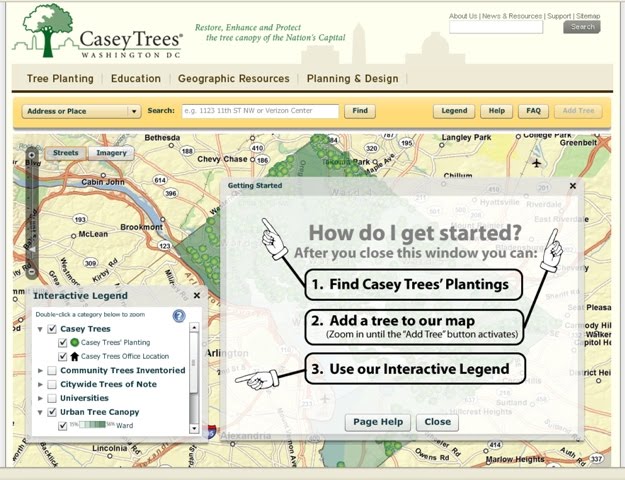
In April 2009, Casey Trees launched the Casey Trees Map, an interactive online tool to help users determine the existing Urban Tree Canopy (UTC) and planting opportunities for any address in the District and identify every tree Casey Trees has planted since 2003.

Just today in a soft launch we rolled out an enhanced version of Casey Trees Map featuring our new Trees of Note program and Add-A-Tree feature.


Trees of Note is a program that connects people to trees in the District deemed special because of their size, history and/or personal significance. Anyone can nominate or locate trees in three distinguished categories – Big Trees, Witness Trees and My Tree.


  • Big Trees are those valued for their sheer size and eligible for nomination to the National Register of Big Trees. The Register lists 826 species of trees. So far DC only has one Champion Tree, located on the U.S. Capitol grounds. Can you find another?
  • Witness Trees are trees present during a historical event or period. Frederick Douglass mentioned the White oak on his front lawn in his journal entries. Think of what that tree saw.
  • My Trees are those with personal meaning. This can be a tree you think has the prettiest blossoms in your neighborhood or even one you got married under. If it is special to you, we want to know about it.
Trees in DC are nominated to the Trees of Note program using the new Casey Trees Map point and click Add-a-Tree feature. The Add-A-Tree feature also allows you to add trees to the Casey Trees Map that you have recently planted in the District. Trees that you add to the map will count towards the City’s Urban Tree Canopy Goal of 40 percent by 2035.

In spring 2010, we will add a new tool that will allow you to update or delete a tree’s information in the event the tree has been removed or misidentified.


Nominating or adding a tree is easy to do own your own but I’ll walk you through the basic steps.


  • To start, go to www.caseytrees.org. The Casey Trees Map is found under Geographic Resources -> Interactive Maps.
  • Simply hit the ENTER button on the opening screen. The second screen provides you with basic prompts including a PAGE HELP button. When you are ready, hit the CLOSE button.
  • To nominate or add a new tree zoom in on the map using your mouse or the zoom tool in the left corner until the button at the top right of the map labeled ADD TREE fills in.
  • Go ahead and click it. Next choose what type of tree you want to add. The button on the left is for trees you have planted, the one on the right is for the Trees of Note program.
  • Scroll on the map to the approximate location you believe the tree is locate and click your mouse. A short form asking you a few questions about the tree will pop up immediately.
  • Fill out the form to the best of your knowledge. If you do not know the genus or species, you may select OTHER from the drop down bar. You may also add a photo. The more information you provide the easier the tree will be to find and confirm.
  • You're done!
What happens after you take the time to add a tree to the Casey Trees Map? A Casey Trees Citizen Verifier will visit the tree and confirm the information submitted. If the nominated tree is on private property the Citizen Verifier will arrange a time that is convenient for you to come out.

The District is much more than bricks and mortar. We hope the Casey Trees Map and Trees of Note program better connects you to the City’s trees, encourages you to visit the neighborhoods these trees are in and gets you to help protect and care for existing trees so we may have more Trees of Note in the future.

Wednesday, December 16, 2009

TREES FOR GEORGETOWN. LITERALLY!


Casey Trees and Trees for Georgetown are partnering to plant 47 new residential street trees in Georgetown. Planting is currently underway and will conclude at the end of the December.

Planting locations include street tree boxes that are empty or those that have dead trees or stumps and stretches of sidewalk that can accommodate new tree boxes.
The District Urban Forestry Administration (UFA) is removing any dead trees and stumps, taking existing tree boxes down to sidewalk level and coordinating the cutting of two new tree boxes.


Casey Trees will amend the soil, plant the trees, hang tree care instruction tags and return to water them twice during the summer and to prune them following the second year. Trees that fail during their first year will be replaced the following planting season.

Trees for Georgetown, an all volunteer committee under the auspices of the Citizens Association of Georgetown (CAG), dedicated to the planting, care and maintenance of residential street trees in the village of Georgetown raises funds through its spring fundraising event and personal solicitations to purchase and plant trees for its residential streets each year. Donations are accepted year round. Trees for Georgetown has donated a portion of these proceeds to Casey Trees to help offset tree purchase and labor costs associated with the beatification project.

In addition to sponsoring new trees for the village, Trees for Georgetown has underwritten custom-made wrought iron fences for each newly planted tree box to shield trees from vehicle doors, yard maintenance equipment and foot traffic.

In the spring, Trees for Georgetown Chair, Betsy Emes, will launch a neighborhood watering campaign emphasizing 25 to Stay Alive – 25 gallons of water (1.5” of rainfall) per tree per week in times of little or no rainfall. Neighbors are encouraged to use irrigation bags, provided free of charge by Casey Trees, to ensure their trees receive the proper amount of water.

“One of the most effective ways a resident can improve the social, ecological, and economic value of a neighborhood is to help ensure that new trees thrive,” said Emes. “In the first two years especially, these new trees need attention to get established. We ask that residents share that responsibility, and in the end we will all benefit from a beautiful tree canopy across Georgetown”.

Eight species of trees will be planted in Georgetown including Nuttel oak, Swamp white oak, Parrotia persica, Sweetgum, London plane, Chinese elm, Zelkova, and Shumard oak.


Photo - Casey Trees field crew in action in Georgetown

Thursday, December 10, 2009

CASEY TREES GIVE THANKS

Contributing Writer - Sue Erhardt, Director of Education

We have all heard that it is better to give than to receive. Casey Trees has had the great fortune to be on the receiving end of people’s time and hard work this year.

It has been Casey Trees privilege to have welcomed over 1700 Citizen Foresters and volunteers over this past year. These dedicated individuals have helped us plant and care for trees all over the District. I would like to thank them for donating over 5300 hours of their precious time to help us advance our Urban Tree Canopy Goal of 40 percent by 2035.


I would also like to highlight the 11 schools that invited Casey Trees to their campuses to plant trees with their students. Schools have different reasons for plantings trees. Sometimes they plant trees for beautification, sometimes they want to incorporate the trees in a science or environmental project, and sometimes reasons can be a combination of both.


The Latin American Montessori Bi-cultural School (LAMB) wanted to plant trees with different leaf shapes to help their students learn about shapes and sizes. For most of the 500 LAMB students this was their first experience planting a tree. It is a great experience to help children feel a sense of accomplishment, and to show them what working together can accomplish. It is truly a powerful experience.

Just below are just two of the many thank you notes we received from LAMB School students following our tree planting with them.


If you like to join the group of selfless people who have chosen to be the change in the District go to www.caseytrees.org and sign up for a class or a monthly Tree Walk.