 |
| Snow falling on leaves, Northwest DC. |

Friday, January 28, 2011


Wednesday, January 26, 2011
Students Care for District's American Elms
At this point in our inaugural American Elm Restoration Awareness Month I am certain you have fallen back in love with the American elm. Maybe you never fell out of love with them. This hearty tree is ideal for urban environments and by planting disease-tolerant American elm cultivars in combination with a number of other tree types we are advancing species diversity, an urban forestry best practice.
So what happens once the American elms are in the ground? We do just what we ask you to do when you plant a new tree - properly water and care for it.
In addition to our tree planting crew who provides regular tree care to the trees we plant, we hire high school students to serve as Summer Crew members for eight weeks each summer. These dedicated teenagers travel in teams by truck and bike to tree sites all across the District to water, weed and mulch the trees. In 2010, Summer Crew members cared for 4,500 trees, far surpassing their goal of 2,500 trees. That is a lot of tree love!
 |
| Summer Crew members in action. |
If you know of a student who might be interested in joining the Summer Crew team, encourage them to apply. Applications are due May 1, 2011.
Our commitment to our American elms doesn't stop there. We also do structural pruning in years three and four as needed. If you think your trees need to be trimmed, consult Good Tree Care to find a certified arborist.
Additionally, we keep residents updated on the work we are doing with American elms near their homes. We have shared our planting schedule with the Councilmembers and ANCs representing areas where American elms are being planted, posted updates on listservs and distributed door hangers in advance of our work. Let us know if there are ways we can improve!
Monday, January 24, 2011
The 'Jefferson' American Elm
Contributing Writer - Carol Herwig, Volunteer Coordinator
The first elm to earn the name 'Jefferson' is on the National Mall near the Freer and Sackler Galleries. It stands out for its shape — it has the traditional vase shape, but with a more rounded crown than the typical American Elm — and its color — it is a darker green. It also leafs out earlier and holds its leaves longer. Those are desirable traits, but more significantly, it has shown resistance to Dutch elm disease (DED).
The 'Jefferson' elm was previously thought to be a hybrid of the Ulmus americana and another species. However, scientists from the National Arboretum have determined the 'Jefferson' elm on the National Mall is a true varietal of the species instead of a hybrid. Planted in the 1930s, the original specimen had survived DED.
However, if you were to purchase a 'Jefferson' — and they are just becoming available commercially — your elm would be a clone of that elm on the Mall. That is the only way to assure that you would be getting the same genetic makeup — the disease-resistance, color and shape characteristics so prized in the original. The first clones were made in 1993 and are just now becoming available commercially. Small 'Jefferson' elms in one quart or one gallon containers are selling for $25 and $40 at the Botany Shop Garden Center in Joplin, Missouri. By contrast, a three foot tall 'Princeton' elm, a disease-resistant cultivar, can be purchased for $12.
I had the privilege of taking a tour of the National Mall's elm trees with Jim Sherald, a plant pathologist with the National Park Service's Center for Urban Ecology who helped test the 'Jefferson' for DED resistance. He showed how the 'Jefferson,' clearly a favorite of his, stands out among the many elms of the Mall. Take the test yourself this spring.
Sunday, January 23, 2011
Cultivars of the American Elm
 |
| 'Princeton' elms near the White House. |
Certain varieties, such as Washington and Jefferson are classic American elms that were planted by the National Park Service in Washington, and can be found on the National Mall and the monumental core of the city. These were naturally occurring varieties but are now reproduced as clones to ensure the identical genetic makeup.
The 'Princeton' cultivar is a variety developed in a nursery; it must be reproduced as a clone or it will revert to one of its parents. 'Princeton,' which can be seen planted in rows in front of the White House along Pennsylvania Avenue, was developed in the 1920s before the threat of Dutch elm disease. It has come into wider use because it has shown good resistance to DED. 'Valley Forge' is a more recent U.S. National Arboretum cultivar and is probably the most resistant to DED. ‘Princeton’ and ‘Valley Forge’ are the primary cultivars Casey Trees has planted during the past seven years. Casey Trees is planting 100 'Valley Forge' elms this winter; in past years, we planted mostly 'Princetons.'
Cultivars vary not just in their disease and pest susceptibility, but also in their form. A ‘Princeton,’ for example, has a dense, symmetrical form with highly acute angles, making for an upright profile. It is notably vase-shaped, a good way you can identify it. The ‘Valley Forge’ also has a vase-shape, but the branching is looser.
There is a good reason why American Elms are cultivated carefully from single specimens rather than hybridized, as is done with many trees to select for certain traits. Hybridization within the genus Ulmus (crossing with other elm species) has been aimed primarily at breeding for DED and phloem necrosis resistance. However, most of the breeding and selection work does not include American elm because it is a tetraploid — that is, it has a chromosome number twice that of all other elms (56 versus 28). Therefore, most hybrid breeding and selection work does not include American elms. Thousands of attempts to cross the American with the Siberian elm have failed. Reports of successful artificial hybridization and verification of hybridizing American elm with other elms are rare.
Facts about American Elm cultivars:
- Cultivars are crosses between clones. They are derived from root cuttings (rather than planted from seeds) to ensure their DED-resistance.
- Although cultivars may be selected for DED-resistance, they may still be at risk for other elm diseases, such as elm yellows and verticillium wilt.
- DED-resistance does not mean a cultivar is immune, but certain ones have significantly improved survival rates compared to other elms.
- There are dozens of named cultivars of Ulmus americana.
Friday, January 21, 2011

Thursday, January 20, 2011
Notable American Elms
Contributing Writer - Carol Herwig, Volunteer Coordinator
Although Dutch elm disease (DED) has diminished many of Washington D.C.'s elm-lined streets and parks, there are a few grand survivors that can be appreciated. Some, such as the grand Lafayette Park elm facing the White House at Madison Street NW and those on the National Mall, receive special attention from the National Park Service. Elm lovers in Mount Pleasant raise money to inoculate their old trees against DED.
Although Dutch elm disease (DED) has diminished many of Washington D.C.'s elm-lined streets and parks, there are a few grand survivors that can be appreciated. Some, such as the grand Lafayette Park elm facing the White House at Madison Street NW and those on the National Mall, receive special attention from the National Park Service. Elm lovers in Mount Pleasant raise money to inoculate their old trees against DED.
 |
| A massive American Elm at the southeast corner of Lafayette Park. |
The American elm towering over the Metro bus stop at Sherman Circle and Crittenden Street NW has a diameter at breast height (DBH) of 5 feet (15.5 feet in circumference) and a crown spread of 90 to 100 feet. Its future is threatened – a lower limb was torn off in last winter's windstorm, leaving a large wound. Rock Creek Cemetery boasts an elm with a DBH of 45 inches and a hundred-foot spread that shades New Hampshire Avenue NW.
The biggest elm in Ward 1, on Ontario Place NW, is nearly five feet in diameter. In Capitol Hill, south of the Capitol off 3rd Street, are some great elms. North Carolina Avenue SE has an mix of survivors and the selections arborists have turned to as replacements: Japanese zelkovas, Chinese elms and more recently, disease-resistant 'Princeton' cultivar American Elms planted by Casey Trees.
 |
| The long-lived John Quincy Adams Elm in 1965. |
Sadly there are many great American Elms that have not survived. An elm on the southeast grounds of the White House, known as the John Quincy Adams Elm, lived from 1826 to 1991 when it was taken down because of structural concerns. A sapling was derived from a root cutting from the original tree and was planted in 1991 by First Lady Barbara Bush, so in a way the ancient tree lives on.
There are also many notable American Elms outside of the District. The national champion elm, according to American Forests' Big Tree survey, is in Ross County, Ohio. It has a circumference of 273 inches (DBH of just over 7 feet), stands 118 feet tall and has a crown width of 100 feet. American Forests, in selecting Big Trees, follows the following formula to determine the Big Tree champion for each species: Trunk Circumference (DBHx3.1416 or pi) + Height + ¼ Average Crown Spread = Total Points. Using those standards, the Sherman Circle tree's formula is 186 inches + 55 (feet) + 25 (feet) = 266. The Ohio tree received 416 points.
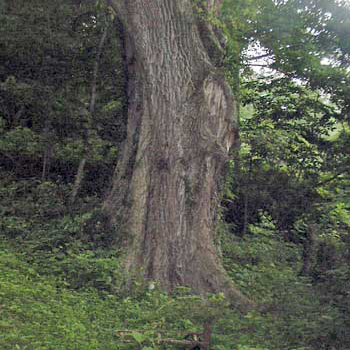 |
| The national champion elm in Ross County, Ohio. |
You can view notable American Elms on the Casey Trees Map. You can even nominate a favorite elm in your neighborhood if it has not yet been selected or look at historic American Elm corridors throughout the District.
Friday, January 14, 2011

Wednesday, January 12, 2011
How to Identify an American Elm
How do you know an American Elm when you see one? Here are some characteristics of American Elms that will help you identify these trees on the streets of DC.
 |
| Note the serrated edge and ovate shape of these emerging elm leaves. |
Features of the American Elm:
- Size: Can reach 100 feet tall or more, but generally mature city trees are 60 to 80 feet.
- Trunk and branches: Vase-shaped with a canopy almost as wide as its height. Thick columnar trunk divides into large branches and then smaller branches that arch outwards. On classic elm-lined streets, mature elms often branch across the roadway.
- Leaves: Alternating simple leaves that are ovate in shape. Doubly serrated with straight veins. Various sizes, but leaves usually are 3 to 6 inches long. Dark green in the summer. Notably, the base is asymmetrical (meaning one side of the leaf is broader than the other). Twigs and buds appear in striking zig-zag formation.
- Fall appearance: Yellow or brown leaves.
- Bark: When mature, dark gray-brown with deep, crossing ridges. Bark can be scaly when young.
- Flowers: Tiny petal-less reddish flowers on pendulous stalks. Not showy. One of the first trees to flower, often in late winter before the leaves emerge.
- Fruit: Small round, flat and papery-looking, with a notch at the apex. They are samaras, containing a single seed, and can be green or yellow.
If you're looking for American elms in the city, the obvious place to look is the National Mall where there are hundreds lining the walkways and surrounding the monuments. Additionally, at Lafayette Park and other sites near the White House there are many elms to see including mature specimens and the "Princeton" cultivar planted by Casey Trees along Pennsylvania Avenue. When Casey Trees inventoried the trees on the grounds of the Smithsonian Institution last year, we documented 165 American Elms, making it the Smithsonian’s most common tree species. Other locations include: New Hampshire Avenue NW (including Dupont Circle), North Carolina Avenue SE/NE and East Capitol Street in Capitol Hill, and Lamont and Park Streets NW in Mount Pleasant.
 |
| The vase-like spread of American Elms on the National Mall. |
Learn more about our American Elm Restoration program on our website, including new planting locations for elms this winter.
Subscribe to:
Posts (Atom)