Monday, February 13, 2012

Mayor Gray Issues Proclamation Congratulating Casey Trees on 10 Years of Service to D.C.


Ten years ago today, Casey Trees opened its doors with a clear mission - restore, enhance and protect the tree canopy of the nation's capital. Together we have planted more than 10,000 trees across the District, educated thousands of adults and youth alike, tracked the health and condition of trees and worked with elected officials, designers and builders to protect existing trees and create spaces to sustain large healthy trees.

Become a Tree Champion today and we can do more. Tree Champions provide Casey Trees with a reliable stream of financial support that enables us to make our trees through our Community Tree Planting program available free of charge to worthy groups and institutions.

For a limited time, our friends at Bare Tree Apparel are thanking individuals like you who become a Tree Champion at the $25 a month level by sending them a hand printed "Plant a Tree" tote. Take satisfaction in knowing that over the course of a year, your monthly gift will sponsor the planting of a single tree and that you will be planting the seed of environmentalism in the mind of every person that sees you carrying your tote.

Pledge to be a Tree Champion today. Hurry, only the first 50 new Tree Champions are eligible to receive a "Plant a Tree" tote.

Today, Casey Trees Turns Ten!

Cue the eco-friendly confetti drop. Hug a loved one. Give your pet an extra treat. It’s time to celebrate.

Our friends at Bare Tree Apparel are marking this milestone by offering a very special gift – a hand printed, limited-edition tote bag - to our friends who become Tree Champions by May 1.

Made from recycled cotton, this eco-friendly tote is perfect for trips to the farmer’s market, library, or a stroll around town and it conveys what we and you consider important – adding trees across D.C. And you will be doing just that when you sign up to be a Tree Champion.

Tree Champions are among our most loyal and dedicated supporters. Their monthly gift of $25 or more – just 82 cents a day – provides us with steady, reliable support to continue providing trees and educational programming at no cost to schools, public parks, recreation centers and other deserving institutions.

When you give monthly, you'll join a community of supporters working tirelessly to forge a green legacy in our nation’s capital for future generations to enjoy. 

Hurry! This gift offer is limited to the first 50 new Tree Champions.

Wednesday, February 8, 2012

Tune in for Tree Talk Thursday Tomorrow!


Don't forget that we're having another Tree Talk Thursday tomorrow from noon until 1 p.m. We will be discussing treescaping and how to design and build with trees in mind, so start thinking about your questions today.

Our hosts this month are Casey Trees' Director of Planting and Design, Maisie Hughes, and guest host Meredith Upchurch, landscape architect with the District Department of Transportation. They will have plenty of answers for your treescaping questions in the hour-long interactive chat.

The chat will be on our website tomorrow at noon, so grab your lunch and join us for an informative hour. If you're afraid you might forget, enter your email address on the page and we'll invite you to the chat when it begins. You can also submit questions ahead of time by emailing us at treedc@caseytrees.org or tweeting us at @CaseyTrees.

Have you missed out on past Tree Talk Thursdays? Past chats are archived online on a variety of topics from the Emerald Ash Borer quarantine to choosing an arborist.

Thursday, February 2, 2012

An Unseasonably Warm Pruning Winter

Contributing writer - Jabbari Brew, Tree Planting Crew

Pruned branches at Casey Trees headquarters.

The first month of the new year is behind us. The field crew's work in January focused on American elms - both planting and pruning. So far we have pruned trees all over the District, along corridors like Massachusetts Avenue, Piney Branch Parkway, East Capitol Street and Nebraska Avenue. We have touched 300 trees in some way, whether it was removing dead or broken branches, structurally pruning, or raising the crown. Pruning trees in the winter is the best practice, as the trees are dormant and the risk of pest problems associated with pruning cuts are minimized, plus the tree has all of the growing season ahead to compartmentalize the wounds. Also the tree is naked in the winter, so it is a lot easier to see the structure of the tree.

At the beginning of January, I fretted about pruning in the cold winter. The thought of climbing up a six-foot ladder to reach a couple of branches in freezing temperatures gave me the shivers. But to my surprise, it has been a pretty warm pruning season. The average temperature on a working day in January was 49 degrees Fahrenheit, and the last day of the month was 65 degrees. It was so warm it felt like we should have been planting trees - not pruning. The warm weather has made pruning more enjoyable. I spent more time with the tree, finding defects to fix and enhancing the structure of the tree, instead of hustling to get back in the warm truck.

Our pruning work focuses on establishing good tree structure and reducing the risk of failures from, for example, co-dominant stems, which are very common in elm trees. Structural pruning is beneficial for several reasons: it helps the tree establish a strong leader, enhances the tree's appearance and form, and influences the ultimate size of branches.

In the field it is fairly easy to judge what works needs to be done in a tree. We like to say, "hit 'em up, hit 'em hard," when the trees are young. Structural pruning is easier on younger, established trees because it is easier to reach the limbs from a ladder and make the cuts. More importantly, the size of the wounds from the cuts will be smaller, and the tree will be able to seal those wounds quicker. For trees that aren't established (trees that have been in the ground for less than two years), we only inspect for damaged or broken branches. On older trees our work is limited to how high we can safely reach with our tools from the ladder. Also with larger limbs, sometimes greater than five inches in diameter, the work becomes more dangerous to both the crew and the tree.

Jabbari pruning a young American elm last winter.

Warm weather has made this pruning season really enjoyable, but it may cut our work short. There's a saying that "pruning is a double-edged sword" - a double-edged saw, I would rather say. Pruning a tree can help or hurt a tree depending on where, when and how the cuts are made. Over the next few days and week we will be carefully observing whether buds are beginning to swell and break. We don't want to prune during bud break or when the leaves are flushing out. I don't know if six more weeks of winter are in store, but the groundhog, Punxsutawney Phil, saw his shadow today, so maybe I will still get some of that dreadful cold winter weather. Fingers crossed.

Punxsutawny Phil Strikes Again

Everyone's favorite groundhog predicted six more weeks of winter this morning, but spring planting for Casey Trees still starts March 3 at the National Zoo with our free Tree Planting Workshop. Advance registration is required; space is limited. All other spring Community Tree Planting events will be made available to volunteers starting next week.

Did you know? A groundhog and a woodchuck are the same thing, and the name woodchuck has absolutely nothing to do with wood or chucking, but is actually a mangled version of the Native American name, otchek.

Wednesday, February 1, 2012

Tree of the Month: Deodar Cedar

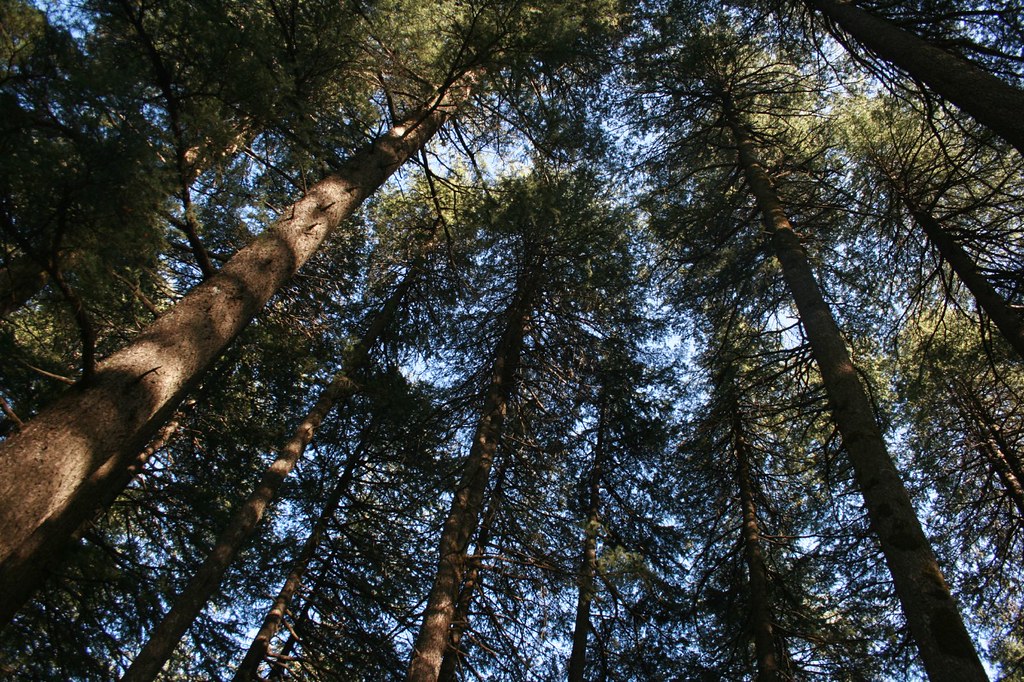
Winter is officially upon us, bringing the cold, snow, and barren deciduous trees. Thankfully, tree lovers can take time to appreciate evergreen trees like the deodar cedar (Cedrus deodara), our February Tree of the Month. While the tree's natural habitat is in the Himalayan Mountains from Afghanistan to Nepal, it has become a popular ornamental tree in the United States. Woody plant expert and horticulturist Michael Dirr calls the deodar "the most graceful cedar" for good reason. The tree is desired for its tall silhouette and gently drooping branches.

The full canopies of deodar cedars in a forest.
Photo credit: draconianrain

The sanskrit root-word for "deodar" roughly translates to "wood of the Gods." An apt name for a tree that can grow up to 250 feet in its natural habitat. These heights are not reached by their ornamental kin in the U.S. Expect to see deodars closer to 70 feet with a maximum spread of 40 feet. Most deodars have a strong pyramid shaped canopy, although some older trees can take on a flat-topped and wide-spread appearance.

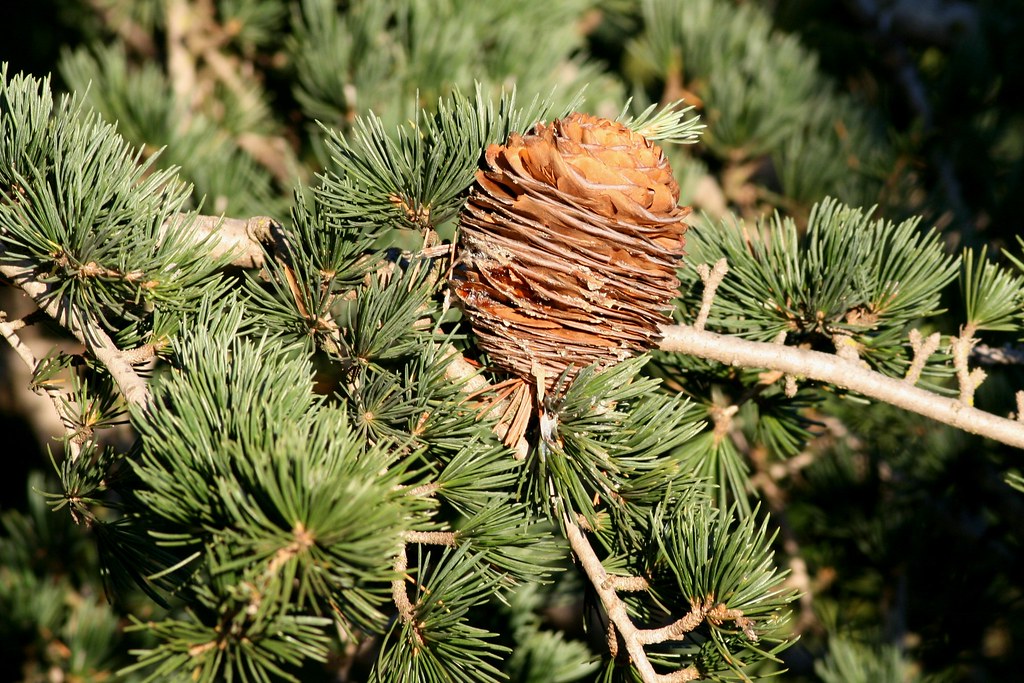
The evergreen leaves of the deodar are needles of 1-2 inches in length and are green or silver green in appearance. The needles droop gently from the tree, giving them their signature appearance. The cones of the Deodar stand upright and are barrel or egg shaped. The cones measure approximately 3-4 inches long and take 2-3 years to develop as they turn from blue to reddish-brown.

The cone of a deodar cedar.
Photo credit: arthur_chapman
Some additional facts about the deodar cedar:
  • The tree grows quickly and has a dense canopy, making it ideal for natural wind breaks.
  • The deodar's wood is desirable as a building material because of its ability to resist rot, durability, and fine grain.
  • The tree's canopy makes an excellent home for smaller animals including birds because of its density
Deodar cedars are common throughout the District. Those wishing to see the trees in public settings can find them at Dumbarton Oaks, the National Arboretum, the National Zoo, the National Gallery of Art Sculpture Garden and on the White House grounds.

Tuesday, January 31, 2012

A New Tool for our Bioretention Planter


If you happen to be in the Brookland neighborhood, cruise over to our headquarters on12th and Irving Streets to see our bioretention planter and our new interpretive panel now stationed at the entrance.

The interpretive panel is an informative introduction to the planning and design that has made Casey Trees headquarters an example of how a small building can help slow and filter stormwater, reduce energy consumption and provide several other environmental benefits. 

If you stop to read the panel, you will learn how bioretention planters work, how Silva Cells help trees reach their full growth potential and what trees are included. We've also included details and photos of our cool roof and three green roofs. From spring through fall, you will be able to catch a glimpse of the green roofs from the location of the panel.


Our bioretention planter is charming and changing all year long, so stop by and take a look the next time you’re in the neighborhood.

Monday, January 30, 2012

Recoup, Green MaidWorks Deal Benefits Casey Trees

Last Monday, Casey Trees announced its exciting new partnership with Recoup. Today, we are happy to share with you the first Recoup deal benefiting Casey Trees - 3 hours of eco-friendly house cleaning for just $99. For each deal sold, Casey Trees receives a $10 donation.

Green MaidWorks - the proven leader in eco-friendly, professional clearning - is providing 3 hours of cleaning for up to 2,000 square feet of space for a fraction of the $250 value. All of their products are Green Seal Approved, non toxic and safe around you, your family and your pets When you purchase the deal for yourself or as a gift, you get ridiculous savings, a clean house and the satisfaction of knowing you helped Casey Trees.

Here is how it works:
  • Sign up for Recoup to receive great deals from your favorite local businesses. Using this hyperlink will automatically designate Casey Trees as the nonprofit you want all of your purchases to support. If you are already a member, log in and choose Casey Trees as the cause you want to support.
  • Purchase great daily deals and save money for yourself or on a gift for others.
  • Choose your donation amount. Recoup automatically donates 10 percent of each purchase to the nonprofit of your choice. You can also increase your donation amount by converting all or part of the rebate value.
  • Enjoy the great deal and satisfaction of doing good in your community!

Take advantage of this great opportunity to shop green, live green, save money, and support Casey Trees.
Sign up for Recoup to get started shopping and help Casey Trees make our city a better place to live.