Showing posts with label Tree of the Month. Show all posts

Thursday, March 1, 2012

Tree of the Month: Yoshino Cherry


March’s tree of the month will be the center of attention around the District in the coming weeks: it’s the Yoshino cherry, the star of the National Cherry Blossom Festival that will kick off March 20 and run for almost six weeks. 

Yoshino cherries are famous for the ethereal beauty of their delicate flowers, which bloom pale pink and then turn white over the course of the two weeks that the trees blossom. This generally occurs late March or early April, and the National Park Service is predicting that this year the infamous cherry trees will hit peak bloom March 24 and  blossom through March 31. Peak bloom is the period that when 70 percent of the blossoms are open. The National Park Service said the mild winter didn't affect the timing of the bloom, but too many more warm days like today could speed up the blossoms' clock.


This year is an especially significant year for the festival, as it marks the 100th anniversary of the original planting of 3,020 Japanese cherry trees in the Tidal Basin. Remarkably, you can still admire some of the centenarian trees, most notably the two planted by First Lady Helen Taft and Viscountess Iwa Chinda, wife of the Japanese ambassador. Look for the bronze plaque on the northwest side of the Tidal Basin commemorating that event.

Photo courtesy of National Cherry Blossom Festival.
The Tidal Basin is the place to go to be caught in a whirl of falling cherry blossoms, but if you’re looking for a slightly less-crowded spot for enjoying Yoshino cherries, try one of these locales:
  • East Potomac Park
  • U.S. Capitol grounds
  • Library of Congress grounds
  • Fort McNair
  • National Arboretum
  • Anacostia Park
  • Foxhall Village
  • Kenwood neighborhood, Bethesda
And keep an eye out for the cherry trees wewill be planting in partnership with the National Cherry Blossom Festival this spring, located in schools and parks around the District.

Wednesday, February 1, 2012

Tree of the Month: Deodar Cedar

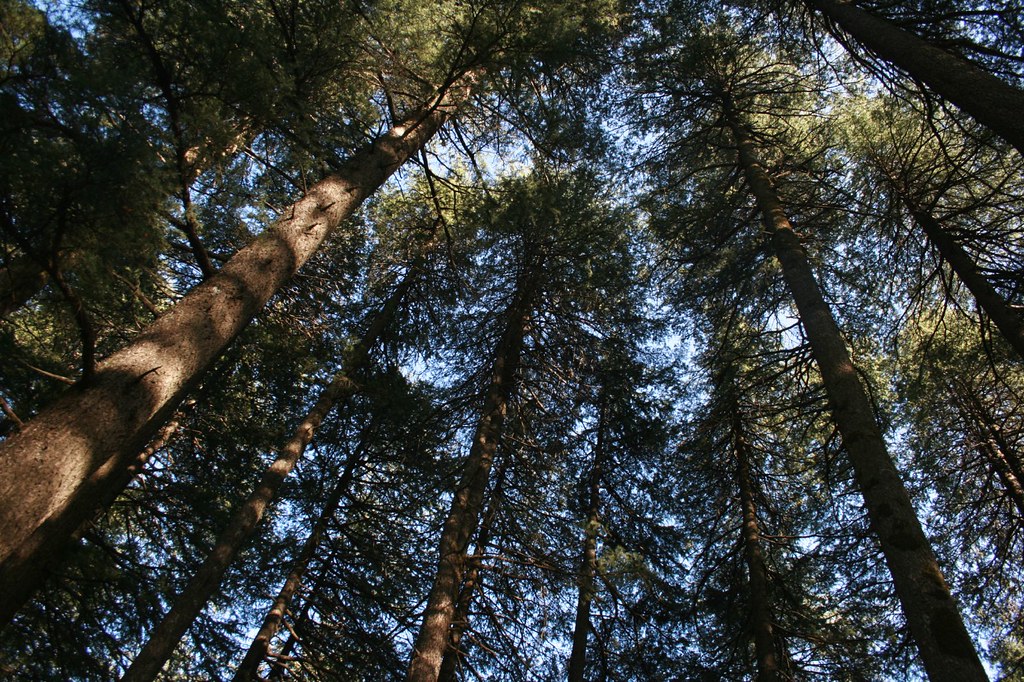
Winter is officially upon us, bringing the cold, snow, and barren deciduous trees. Thankfully, tree lovers can take time to appreciate evergreen trees like the deodar cedar (Cedrus deodara), our February Tree of the Month. While the tree's natural habitat is in the Himalayan Mountains from Afghanistan to Nepal, it has become a popular ornamental tree in the United States. Woody plant expert and horticulturist Michael Dirr calls the deodar "the most graceful cedar" for good reason. The tree is desired for its tall silhouette and gently drooping branches.

The full canopies of deodar cedars in a forest.
Photo credit: draconianrain

The sanskrit root-word for "deodar" roughly translates to "wood of the Gods." An apt name for a tree that can grow up to 250 feet in its natural habitat. These heights are not reached by their ornamental kin in the U.S. Expect to see deodars closer to 70 feet with a maximum spread of 40 feet. Most deodars have a strong pyramid shaped canopy, although some older trees can take on a flat-topped and wide-spread appearance.

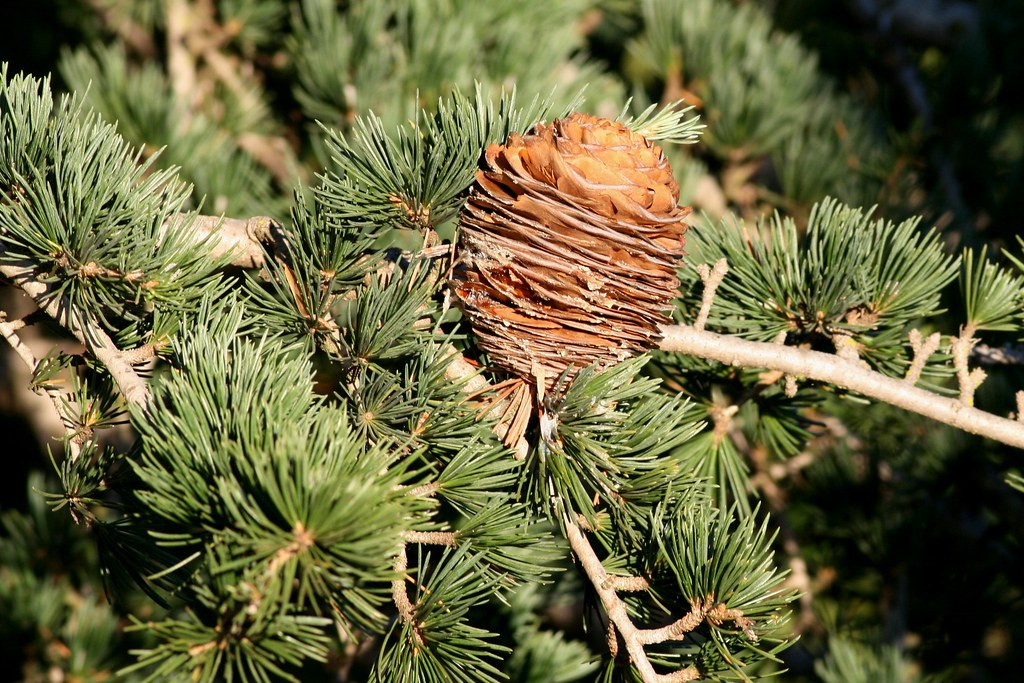
The evergreen leaves of the deodar are needles of 1-2 inches in length and are green or silver green in appearance. The needles droop gently from the tree, giving them their signature appearance. The cones of the Deodar stand upright and are barrel or egg shaped. The cones measure approximately 3-4 inches long and take 2-3 years to develop as they turn from blue to reddish-brown.

The cone of a deodar cedar.
Photo credit: arthur_chapman
Some additional facts about the deodar cedar:
  • The tree grows quickly and has a dense canopy, making it ideal for natural wind breaks.
  • The deodar's wood is desirable as a building material because of its ability to resist rot, durability, and fine grain.
  • The tree's canopy makes an excellent home for smaller animals including birds because of its density
Deodar cedars are common throughout the District. Those wishing to see the trees in public settings can find them at Dumbarton Oaks, the National Arboretum, the National Zoo, the National Gallery of Art Sculpture Garden and on the White House grounds.

Thursday, December 1, 2011

Tree of the Month: American Chestnut

Though today is the first of December,  you have probably already heard Christmas tunes on the radio for weeks. It's hard to think of the holidays without getting that lyric about chestnuts stuck in your head. For that, you can thank the American chestnut (Castanea dentata), our December Tree of the Month.

Before the early 1900's, there were approximately 4 billion American chestnut trees in the Northeast. They stood up to 110 feet tall and provided delicious nuts for street vendors to roast and sell during winter months. But due to a fungus-related disease called chestnut blight, American chestnuts rapidly disappeared. Fortunately, chestnut blight does not kill the tree's roots, so some sprouts survived. Today there are hundreds of healthy American chestnuts in the mountains of Michigan and Pennsylvania.

An American chestnut. Photo credit: njheart2heart
Since American chestnuts are somewhat rare in D.C., finding one is a special treat! You can find two American chestnut trees on the grounds of the Smithsonian National Museum of Natural History and one that was planted in 2005 near the U.S. Department of Agriculture. More American chestnuts can be found in surrounding areas such as Glencarlyn Park and Sugarloaf Mountain.

How can you tell if you've spotted a rare American chestnut?
  • The leaves are simple and alternate and are usually between five and nine inches long. They are yellow-green and have sharply toothed edges.
  • The flowers are yellow cylindrical clusters, between four and nine inches long. They bloom between the late spring and early summer.
  • The edible chestnuts grow inside of prickly burs. Up to three nuts can be found in one shell. They sprout in early autumn. 
The jagged edges of an American chestnut leaf. Photo credit: njheart2heart
Be mindful not to confuse the American chestnut with its non-native relative the Chinese chestnut (Castanea mollissima). Chinese chestnuts have similar characteristics, but their leaves are identifiable by their dark, glossy green color and shorter length.

Wednesday, November 2, 2011

Tree of the Month - Scarlet Oak

The chill of last weekend may have stripped some trees of their foliage, but many will retain their leaves late into the season, including our November Tree of the Month, the scarlet oak (Quercus coccinea). It is the official tree of the District of Columbia and has some of the most brilliant colors you will see this season. Its deep red autumn colors appear late in the fall season and give the tree its common name. The scarlet oak is native to the Eastern United States. Its habitat stretches along most of the Appalachian Mountains, but can also be found in Southern Indiana, Southeastern Missouri and Mississippi.
Scarlet oak leaves.
Photo credit: Jason Hollinger
The scarlet oak shares many similarities to its close cousin, the pin oak, but several key features make it easily identifiable. The scarlet oak's acorn is larger at one half to one inch long and features a deep cup that covers almost half of the nut. The scarlet oak also features ascending branches that can form an open, rounded or irregular crown that looks markedly different from the horizontal and drooping branches of the pin oak.

The scarlet oak's leaves are simple and oval shaped with deep C-shaped cuts that create up to nine bristly lobes. The leaves are a bright and shiny green on top with a paler shaded underside and are usually three to seven inches long. The leaves autumn colors range from a subtle russet to the deep scarlet coloration the tree is famous for.

Facts about the scarlet oak
  • The scarlet oak prefers dry and sandy soils especially along ridges and slopes
  • The tree's canopy can spread up to 50 feet in diameter
  • The scarlet oak's acorns are a food source for gray squirrels, mice, deer, wild turkey and other birds
  • Their taproot system can make the scarlet oak difficult to transplant
  • These trees can fare droughts much better than other trees
A scarlet oak on Hobart Street in Mount Pleasant.
The scarlet oak can be found in a variety of locations throughout the District, but some of the more famous locations include the grounds of the White House, Supreme Court, and the Capitol. They can also be found along New Hampshire Avenue NW, the Mount Pleasant neighborhood, Tudor Place in Georgetown, and Rock Creek Park. One notable example is the 2006 Champion Scarlet Oak at 3374 Minnesota Avenue SE. Be sure to search for scarlet oaks that we have planted on our interactive Casey Trees Map. Just select "Casey Trees' Plantings" and type "scarlet."

Wednesday, October 5, 2011

Tree of the Month - Black Gum

We've chosen the black gum (Nyssa sylvatica) for our October Tree of the Month. Its leaves turn vibrant red in early autumn, before most other tree species put on their fall color. In the District we may not see the bright change until the end of the month, but it is a notable tree to look out for.

The black gum — also called black tupelo or sour gum — is a native tree found throughout eastern North America, from Southern Ontario and Maine all the way to Florida and Texas. It is a medium-sized deciduous tree, usually maturing at a height between 66 and 82 feet.

A black gum's brilliant fall color stands out against more late-changing leaves. Photo credit: dogtooth77.

You can easily identify a black gum by its:
  • Dark and furrowed bark. Some black gum bark resembles the scales of an alligator, making it particularly easy to recognize.
  • Leaves, which are simple and oval-shaped with a rounded base. Dark green and glossy in the summer and peach or wine-red in the fall, the black gum's leaves are typically about two to six inches long.
  • Small and greenish-white flowers, appearing in springtime with the leaves.
  • Fruit, which blossoms when the leaves change color. Due to its early arrival, the sour fruit of a black gum attracts a lot of birds in early autumn. 

Photo credit: Mr.Mac2009
Photo credit: mccormacka

    Though black gums prefer swampy areas and highly acidic soil, you can find them in various locations around D.C., including at the National Arboretum, the Kenilworth Aquatic Gardens, the White House south lawn and Rock Creek Park.

    Fun facts about the black gum:
    • High in fat and fiber, the tree's fruit is an important food source for black bears
    • In colonial times, the strong wood of the black gum was used for water pipes
    • During spring season, the black gum qualifies for our RiverSmart Homes program!

    Monday, August 1, 2011

    Tree of the Month: American Linden

    The heat of mid-summer is well underway in D.C. If outdoor shade is what you seek, refuge under our Tree of the Month for August, the American linden (Tilia americana), just may provide some relief.

    The American linden, also commonly known as American basswood or lime, is a tree native to North America and traditionally found throughout New England, Quebec, New Brunswick, the Great Lakes region and downward into the South. When fully mature, the American linden can grow to a very impressive size, with fully developed specimens ranging from 75 to 130 feet in height and three to four feet in diameter.

    This American linden towers over surrounding structures.

    There are a few noteworthy characteristics to help identify the American linden. Its bark is vertically ridged and gray in color, with quite long, overhanging limbs. In late June or early July, small, yellow clusters of flowers bloom at the tip of its branches - a fragrant attraction for honeybees, eager to extract pollen for their production of sweet honey. It is also a deciduous tree, meaning that in just a few months its canopy will be ablaze with autumn color, eventually shedding its leaves for the winter months.

    Facts about the American linden:
    • It's leaves are heart-shaped and deep green in color on top with a paler shade underneath.
    • The Japanese beetle finds its leaves particularly tasty, as they are susceptible to the invasive insect.
    • Their extensive, sprawling root system can support a lifespan of 100 to 150 years. 
    • It qualifies for our tree rebate program (up to $100 per tree).

    American lindens originally lined Massachusetts Avenue during much of the nineteenth and early twentieth centuries. Recently, plantings by the Urban Forestry Administration and the work of the nonprofit group Restore Mass Ave have aimed to restore and protect the historic integrity of the American linden along the avenue. The U.S. Capitol Grounds is another location in the city for some great examples of the tree. You can take a look at the Casey Trees Map to locate American lindens across D.C.

    Friday, July 1, 2011

    Tree of the Month: Japanese Pagoda Tree

    Spring has definitely passed! While you may associate the end of spring with the end of beautiful blossoms, there are still some sweet-smelling flowers to look forward to this summer. The Japanese pagoda tree (Sophora japonica or Styphnolobium japonicum), our Tree of the Month for July, could hit its three-week bloom period any time from now until early September.

    Photo Credit: geneva_wirth

    Despite its name, the Japanese pagoda tree does not come from Japan. This ornamental tree is native to China, Korea and Vietnam. It usually grows 25 to 35 feet tall but can sometimes reach heights of up to 100 feet! Some identifying characteristics are its oval leaflets, gray-brown bark, and shiny green twigs. The tree’s compound leaves, which range from 6 to 10 inches in length, contain 7 to 17 ovate dark green leaflets. The bark is marked by wavy ridges. Keep your eyes and nose peeled for the Japanese pagoda's white fragrant flowers which are arranged in loose clusters.

    Fun (for the most part) facts about the Japanese pagoda:
    • During the Chou Dynasty in China, it was customary to plant the Japanese pagoda tree near the tombs of high officials. 
    • Our Tree of the Month is a member of the pea family fabaceae. 
    • The Japanese pagoda tree is also called the Chinese scholar tree and the honey tree.
    • Sophora japonica 'Pendula', known as the weeping Japanese pagoda, is a cultivar of our Tree of the Month. The weeping Japanese pagoda rarely blooms. 

    Photo Credit: Jane Starz.
    Note the wavy bark of the Japanese pagoda tree. Photo credit: geneva_wirth.

    Japanese pagoda trees can be found in various places around the District including on the Capitol grounds and at Dupont Circle, Lincoln Park and the National Cathedral. In 2006, Casey Trees named a Japanese pagoda tree in President’s Park near E Street the District’s champion pagoda tree. To find Japanese pagoda trees planted at Community Tree Planting events, search "Pagoda" on our interactive plantings map.

    Wednesday, June 1, 2011

    Tree of the Month: Northern Red Oak

    Summer doesn’t officially start until June 21st but it seems the weather didn’t get the memo. D.C. has been sunny and beautiful lately, but brutally hot. Heat advisories were issued last week when high temperatures far surpassed the average for May. And with forecasted temperatures in the nineties again this week, escaping the early summer heat may seem an impossible feat.

    Cue the northern red oak (Quercus rubra), our Tree of the Month for June. With dense leaf coverage and a typical height of almost 100 feet, the Northern red oak is one of the best shade trees D.C. has to offer on scorching afternoons.

    Photo credit: Nigel Cox.

    The northern red oak is native to the northeast region of the United States and southeast Canada. You can recognize the tree by its distinctive bark, leaves, and acorns. Mature trees have dark grey or brown bark with broad, shiny strips on the trunk’s ridges. Its leaves are lustrous dark green on both sides, with seven to eleven sharp lobes. The tree’s acorns are typically two to three centimeters long and have a reddish-brown cup on one end. Unlike the white oak, a red oak’s acorns stay on the tree through the winter.

    Pointy lobes and brownish-red stems and twigs of a northern red oak. Photo credit: Maggie.

    Red oak seedlings need to be planted in open areas, as they require a light intensity of about 30 percent to grow. Small sprouted trees should be given a planting space of at least 8.5 square meters. If you are interested in planting a northern red oak tree, don’t forget about our Tree Rebate Program! The red oak qualifies as one of our rebate program’s large shade trees likely to thrive in the District. You can find red oaks in a lot of places in D.C. including: McPherson Square, Cleveland Park, Dumbarton Oaks, Logan Circle and Woodland-Normanstone.

    Northern red oak facts:
    • Northern red oaks can thrive in forests and cities, as long as they have enough space. 
    • They have a fast growth rate of about 2 feet per year.
    • Northern red oaks’ acorns are a treat for many animals, including ruffed grouse, blue jays, wild turkeys, fox squirrels, bears, deer, and raccoons.
    • On rare occasions, the red oak can live to be 500 years old! More commonly, they tend to stay healthy for about 150 years.
    Red oak in November in Mount Pleasant.
    To find all the northern red oak trees Casey Trees has planted around DC, check out our Plantings Map and search for “oak, red” under the category Casey Trees’ Plantings. You can also find Northern red oak street trees on our DC Street Trees Map, or read a blog post that we wrote on a notable northern red oak last spring. As temperatures continue to climb, keep your eyes peeled for these wonderful shade trees. They can help you escape from the blistering heat but still enjoy the beautiful weather!

    Thursday, March 3, 2011

    Tree of the Month: Serviceberry

    A precocious tree, the serviceberry (Amelanchier arborea) is one of the first trees to bloom in the spring. Its creamy white or pale pink star-shaped flowers bloom in loose clusters toward the tips of the branches soon after the ground has thawed in March and April.

    A serviceberry in bloom.
    Photo credit: Paul Wray, Iowa State University, bugwood.org

    Songbirds and mammals, including black bears, eat the serviceberry’s fruit, which are small and round and red, purple and black in color. The tree fruits in early summer until August.

    The ovate leaves have small, sharply pointed teeth and fine, soft hairs on the surface when young. Serviceberries are native to woodlands in the United States from the Great Plains eastward to the coast and north into Canada.

    Seviceberry leaves and fruits.
    Photo credit: John Ruter, University of Georgia, bugwood.org

    Facts about the serviceberry:
    • The fruit of the serviceberry tastes like a blueberry and is eaten fresh or used in pastries and desserts.
    • In some regions, the flowers are gathered for religious services, thus giving this tree its common name.
    • George Washington enjoyed the serviceberry and planted several specimens at his Mount Vernon estate.
    Use our interactive map to see where we have planted serviceberries. Search for "Serviceberry" under the category Casey Trees' Plantings. Casey Trees has planted 402 varieties of serviceberries, with plantings in every ward of the city. Keep your eyes out for the serviceberries’ beautiful blooms this spring and when the berries begin to show, harvest them and make a pie!

    Wednesday, February 2, 2011

    Tree of the Month: American Sycamore

    Peeling sycamore bark.
    Some deciduous trees have a distinctive appearance in the winter, even without their leaves. The American sycamore (Platanus occidentalis) is one of these trees. Several trees are commonly called sycamores, but the native American sycamore (also known as the American plane tree, occidental plane tree or buttonwood) is a prominent tree in the forests and waterways of the eastern United States.

    The sycamore stands out with its interesting bark, which separates into scaly plates that create a multicolored, mottled texture. The bark peels off, uncovering new white, brown, gray and green layers underneath. All trees with bark go through a process similar to this, but the sycamore shows off its transformation as it grows. Another interesting feature of the tree in the winter is its large round fruit which hang on long stalks. These fruit are prominent throughout winter; they break up and disperse their seeds in the spring.

    American sycamore leaves and fruits.
    Photo credit: Allen Bridgman, South Carolina
    Dept. of National Resources, bugwood.org

    The sycamore's twigs branch out in a zigzag formation, with buds formed at each angle. Its broad palmate leaves have three or five pointed lobes with teeth lining the margins. The tree can be found in river and stream areas, particularly along the Anacostia and Potomac Rivers and the C&O Canal. Casey Trees planted them along the Anacostia in 2006 in Wards 7 and 8. There is also a notable sycamore in the park at Franklin Square.

    Sycamore at Franklin Square's northwest corner
    at a Casey Trees Citizen Forester training.

    Facts about the American sycamore:
    • A close relative, the London planetree is more commonly found as a street tree in DC because it is more resistant to soil compaction and pollution. The London plane (Platanus x acerifolia) is a cross of the oriental plane and the American sycamore.
    • Although it doesn't often have the chance to do so in a dense city, the sycamore can grow to be quite massive -- more than 100 feet tall and very wide.
    Use our interactive map to see where we have planted American sycamores. Search for "sycamore" under the category Casey Trees' Plantings. Casey Trees has planted 30 sycamores and we have planted more than 250 of its hardier relative, the London planetree.

    Thursday, December 2, 2010

    Tree of the Month - American Holly

    Now that winter is approaching and the leaves of many deciduous trees have fallen, some of the most vibrant trees in our city become more apparent. The American Holly (ilex opaca) is an understory tree that is most prominent from October through the winter, with the arrival of its red berries that contrast with its dark evergreen foliage.

    Holly fruits and leaves up close.
    You will recognize an American Holly by its gray bark and its small and stiff oval-shaped leaves, which have spiny thorns along the edges. The leaves usually grow densely and the tree's overall shape tends to be pyramidal. When ripe, its small round fruits are usually bright red. White-petaled flowers come out in the spring. It is a small tree, and while it can get over 50 feet tall, it often grows far shorter than that, thriving in the shade of taller trees.

    For many, this green and red tree represents Christmas. The American Holly was recognized by early settlers as being similar in appearance to the English Holly (ilex aquifolium) which was traditionally associated with the holiday, and is used decoratively. The native range of the American Holly is limited primarily to the mid-Atlantic and southeastern United States regions, spreading as far west as east Texas and as far north as Massachusetts. That means that the often humid climate of Washington, DC suits the tree quite well, although it is tough enough to handle our cold and occasionally snowy winters.

    Two American Hollies
    Facts about the American Holly:
    • The American Holly is the state tree of Delaware.
    • Ilex opaca is dioecious, meaning that the plants have either male or female flowers. Only females produce berries. Many people prefer the female variety, which is why you will find more hollies with berries on streets and in gardens.
    • There are over 1,000 different cultivars and hybrids of the American Holly species.
    Use our interactive map to see where we have planted American Hollies. Search for "Holly, American" under the category Casey Trees' Plantings. Casey Trees has planted over 170 American Hollies, with plantings in every ward of the city. Walk around town this winter and you'll realize that this little tree can be found nearly everywhere!

    Tuesday, June 1, 2010

    TREE OF THE MONTH - SOUTHERN MAGNOLIA


    Last month we highlighted the Sweetbay Magnolia, a beautiful, sweet-smelling ornamental tree. Today we want to highlight its larger cousin, the Southern Magnolia (Magnolia grandiflora) or bull bay.

    The Southern Magnolia is native to the southeastern United States, stretching from coastal North Carolina, south to central Florida and then west to Texas. It is found on the edge of bodies of water and swamps.

    Like most Magnolia species, the Southern Magnolia has large, fragrant, cream-colored flowers and evergreen leaves that make it a wonderful tree for ornamental use and an effective windbreaker or street tree.


    The Southern Magnolia can grow up to 80 feet and have a spread of up to 40 feet if given the proper care. The leaves are dark green, stiff and leathery. Each grows about 5 to 8 inches long and has smooth margins. The bark is brown to gray, thin and smooth when young. The white, citronella-scented flowers bloom from April to June and attract birds and insects.

    Facts about the Southern Magnolia that you can use as ice breakers at your next party:
    • Symbolic of the American South, the Southern Magnolia is the state tree of Mississippi and the state flower of Mississippi and Louisiana.
    • The largest known Southern Magnolia is located in Smith County, MS. It is 122 feet tall and has a diameter of 6 feet.
    • In some parts of England, the flowers are pickled and eaten.

    Friday, April 2, 2010

    TREE OF THE MONTH - LIRIODENRON TULIPIFERA

    I go by two names, the Liriodenron tulipifera goes by five- tulip tree, American tulip tree, tuliptree, tulip poplar or yellow poplar – and it is not even on the run from the law. No matter what you call it the tulip tree, it is a pretty fantastic tree to plant in the District. Three states – Indiana, Kentucky and Tennessee - love it so much they have even made it their official state tree.


    Native to the eastern states, the tulip tree is a fast growing deciduous tree that produces pale green/yellow flowers starting at the top of April in the south and in mid April in DC. As you would imagine, the flowers bare a striking resemblance to actual tulip and stand upright. Unfortunately most of the flowers are borne in the higher reaches of tree and cannot be readily seen. The bark is gray with stripes of light gray in the furrows, its leaves extend about 6 inches long and wide, alternate and are heart-shaped. In the Autumn, the leaves become quite showy turning golden yellow to clear yellow. The tulip poplar easily reaches 70’ to 90’ in height and takes on an irregular shape as it matures. You can easily describe their trunks as massive.
    Plant the tulip tree in full sun, deep, moist, fertile soil and with ample space to grow. The tulip tree is an ideal shade and landscaping tree.
    Fun facts:
    • The tulip tree, while not the most prevalent tree species in DC is one of the largest. As such the tulip tree provides the most ecosystem benefits of any tree species for the City since these services are tied directly to the tree's biomass i.e. total size, leaf area index, etc.

    • When harvested from the forest, its soft wood is used for interior finishes in houses, siding, carriage panels and even coffin boxes.
    • It is a major honey plant in the eastern US, producing a dark and strong honey preferred by bakers.
    Be sure to locate all Casey Trees-planted tulip trees using the Casey Trees Map and add those that you have planted or are on your property but not yet on the map.

    Wednesday, March 3, 2010

    TREES OF THE MONTH - EASTERN REDBUD & KATSURA

    Contributing Writer - Clea Levinson, Intern

    As the weather slowly warms and thoughts of three feet of snow are distant memories, we can turn our attention to the beginnings of spring. Early March is the perfect time to watch your favorite tree go from thin branches with dormant leaves to the colorful spectacle we know and love.

    We are kicking off our new Tree of the Month series by highlighting two trees that bloom purple or red before leafing out - the Eastern redbud and the Katsura tree.


    The Eastern redbud (Cercis canadensis) is a large shrub or small tree that is native to eastern North America. It can be found from southern Ontario to northern Florida.

    The trunk tends to be dark in color and smooth and forms scaly ridges appear once mature. The leaves are alternate, simple and heart shaped. At 3-5" long and wide, they tend to be thin and papery and may be slightly hairy below. Flowers are light pink to dark magenta, and they bloom in clusters on the branches from March to May.

    The Eastern redbud is a hardy, fast-growing ornamental tree that does well in dappled shade. Although you won't see them in your local Safeway any time soon, the redbud flowers and seeds are edible. Native Americans used to eat the flowers raw or boiled and the seeds roasted.

    Casey Trees has planted 351 redbuds across the District including at Marie Reed Learning Center, along Massachusetts Avenue NW and Harbor Square.


    The Katsura tree (Cercidiphyllum japonicum) is native to China and Japan.

    It is a medium-sized, deciduous tree often grown for its foliage. It grows 40 to 60' tall and often has multiple trunks. The leaves of the Katsura tree are heart-shaped and go from mid-green in the spring/summer to yellow, red and orange in the fall. Katsura is the Japanese name for the tree while the scientific name refers to the resemblance of its leaves to the redbud. Not to fear, Katsura tree leaves can easily be distinguished because they are opposite, not alternate.

    This tree likes a lot of sun and can get quite large given space. While fast growing, they are sensitive to drought and need permanent moist soil. It’s also been noted that in autumn the fallen leaves give off a caramel sugar smell. Take note - while they may smell like caramel, they certainly do not taste as such.

    Casey Trees has planted 25 Katsura trees across the City including at St. Paul's Rock Creek Church, Our Lady Queen of the Americas and at the University of the District of Columbia.

    Casey Trees plants both the Eastern redbud and Kastura at Community Tree Planting events. Both also qualify for our $50.00 Tree Rebate program.

    To find all of Casey Trees-planted Eastern redbuds and Katsura trees on the Casey Trees Map, click here. I also encourage you to add any Eastern redbuds, Katsura trees or any other tree species you have recently planted or an existing one that is not included to the map.