Friday, January 27, 2012

Vote Casey Trees Best Non-Profit, Best Place to Volunteer


You've volunteered with us, participated in our free classes and tree tours, received trees and planting help, read our blog and e-newsletter and now we are asking you to show us a little love by voting us Best Place to Volunteer AND Best Non-Profit in the Washington City Paper's 2012 Readers' Poll.

 
Why is your vote important?

It helps spread the word about Casey Trees' programs and the importance of trees, recruit new volunteers, secure critical funding and add more trees across the District. Plus everyone loves a little validation.

Voting takes just a second so vote us Best Non-Profit AND Best Place to Volunteer now and encourage your friends, family, coworkers, household plants and pets to do the same. All that is a needed is a valid email account!

Poll closes March 1 at 11:59 EDT.

Wednesday, January 25, 2012

Stranger Danger - Dutch Elm Disease


As lovely as our American elms are, they are constantly threatened by Dutch elm disease (DED), Ophiostoma novo-ulmi and O. ulmi. This is a fungal infection that spreads from diseased trees to healthy trees through contact, often by beetles carrying the fungus, but also through the root systems and by well-intentioned individuals with their pruning shears. These people, sometimes even trained arborists, can spread the very disease they’re trying to eradicate if some basic steps aren’t taken. 

  
DED symptoms appear in individual branches, turning the leaves yellow or brown and withered. Meanwhile, the disease is spreading through the vascular system of the tree (the way it gets its water), affecting other branches and eventually taking down the whole tree. That can happen in just one season.

American elms in the District have a 5 percent chance of dying because of DED. There are American elms that are resistant to DED, but those cultivars are susceptible to other threats. The best practice is to identify infected branches early and eliminate the offender before the disease has a chance to spread.

If you want more information on identifying and managing DED in your trees, you can read
this report by the Department of Agriculture’s Forest Service. Also visit our website for information on our American Elm Restoration Program.

Tuesday, January 24, 2012

No Winter Blues Here—Only Winter Greens

Did you know that even in the dead of winter, there is still a lot going on with the urban forest of D.C.? Come to one of Casey Trees’ three upcoming courses to learn about winter characteristics, year-round advocacy, or the pesky bugs that continue to threaten our trees. Advance registration is required and space is limited—sign up today so you don’t miss out on any of the fun!

Trees 201 – There’s still time to sign up for this weekend’s workshop! Come learn some of the ins and outs of our city’s trees, including their year-round characteristics and how they complement their neighborhoods. This class is geared toward Citizen Foresters and Project Organizers, but anyone interested in learning about the right tree in the right space is welcome.
Saturday, January 28, 9 a.m. – 2 p.m. at Casey Trees headquarters.

Stand Up for Trees – Since trees can’t stand up for themselves, we will teach you how to successfully advocate for trees in your community. We will show you the tools the District provides, and community members will be there to share their stories and advice. Stand Up for Trees is a Citizen Forester-qualifying course.
Saturday, February 4, 9 a.m. – 2 p.m. at Casey Trees headquarters.

What’s Bugging D.C. – The critters in D.C. aren’t limited to adorable squirrels and song birds, we also have our share of major pests that threaten our urban forest. Come learn what is being done to mitigate these threats and how you as a concerned neighbor can help.
Wednesday, February 8, 6 – 9 p.m. at Casey Trees Headquarters.

Trees 201 participants on a tree walk around Brookland.
Sign up for these courses and more on our Calendar of Events. All courses are free!

Help the U.S. National Arboretum Chart a New Course

The U.S. National Arboretum (USNA) is a 446-acre research, education and public display garden administered by the U.S. Department of Agriculture's Agricultural Research Service. It is also a valued Casey Trees partner. In 2011 alone, we co-hosted two tree tours and led a tree climbing workshop for our High School Summer Crew team members on the USNA grounds.

The USNA has entered into a process to put itself on a path to new relevance, sustainability and progress. Please help the USNA and its Strategic Planning Task Force chart a new course. Whether you are a frequent USNA visitor or have yet to visit, you are a stakeholder and your opinion matters.

Take the short survey now.

Monday, January 23, 2012

Casey Trees Announces Partnership with Recoup Helping You Save Money – and Trees


A new year and a new partnership for Casey Trees! We are excited to announce that are partnering with Recoup, an online marketplace where people can buy brands they want while supporting causes they care about.

How It Works:
  1. Sign up for Recoup to receive great deals from your favorite local businesses. Using this hyperlink (http://www.recoup.com/org/CA200) will automatically designate Casey Trees as the nonprofit you want all of your purchases to support. If you are already a member, log in and choose Casey Trees as the cause you want to support.
  2. Purchase great daily deals and save money for yourself or on a gift for others.
  3. Choose your donation amount. Recoup automatically donates 10 percent of each purchase to the nonprofit of your choice. You can also increase your donation amount by converting all or part of the rebate value.
  4. Enjoy the great deal and satisfaction of doing good in your community!
Support what you love by buying what you want. Sign up for Recoup today and help us continue restoring the tree canopy of the nation’s capital.

To donate directly to Casey Trees, please visit our website.

Friday, January 20, 2012

Congrats to Our Newest ISA-Certified Arborists!

Casey Trees just got smarter and more skilled! Two of our staff members - Mike Nelson and Michael Ferguson - just became International Society of Arborists (ISA)-Certified Arborists. We are gushing, just gushing.

Michael Ferguson cleans his pruning sheers.
Mike Nelson prunes an American elm tree.
What is a Certified Arborist and why are we so proud of Mike and Michael? A Certified Arborist is an experienced professional who has passed an extensive examination covering all aspects of tree care. It's a big deal because we know that when Mike and Michael plant trees through our RiverSmart Homes Shade Tree or Community Tree Plantingprograms, perform structural pruning or consult on tree care and health issues, their actions and advice are rooted in experience, hands on training and continuing education.

Congrats gents to a job well done!

Michael explains below just how and why he and Mike chose to become Certified Arborists. Read on.


Mike Nelson and I have worked on the tree planting crew for about 18 months. In that time, we've learned a great deal about planting, watering and pruning trees and arboriculture in general.

Eager to learn more about trees and urban forestry we have attended several Casey Trees training opportunities and attended the Mid-Atlantic Chapter, International Society Arboriculture (MAC-ISA) Conference. With this base of knowledge, we set out to become ISA-Certified Arborists. We both believed that becoming Certified Arborists would help us better understand how our actions in the field can affect trees and the surrounding environment and help us mentor our fellow crew members.

In preparation for the Certified Arborist exam we joined MAC-ISA and registered for a MAC Arborist Certification Course. Before the course we studied the Arborist Certification Study Guide, Principles and Practices of Planting, Trees and Shrubs and ISA Best Management Practices. Mike and I found the arborist certification course extremely helpful and we especially enjoyed the teaching style of Joseph Murray, an expert in the field.   

The prep course itself covered a wide array of tree topics including tree biology, urban forestry, pruning, tree risk management and safe work practices. After class we exchanged notes and reviewed practice questions. Following three days of coursework we took the certification exam consisting of 200 multiple choice questions. A few weeks later we received our results and were happy to learn that we both passed and were ISA-Certified Arborists!

There is a lot to know to properly manage trees. Being a Certified Arborist tells co-workers, volunteers and industry professionals that we employ the latest techniques in carrying out the mission of Casey Trees - to restore the tree canopy of D.C.


Learn more about why it is important to hire a Certified Arborist and when. We even give you tips for hiring a Certified Arborist.

Thursday, January 19, 2012

American Elms Get Pruned. Check Out the Video Montage!

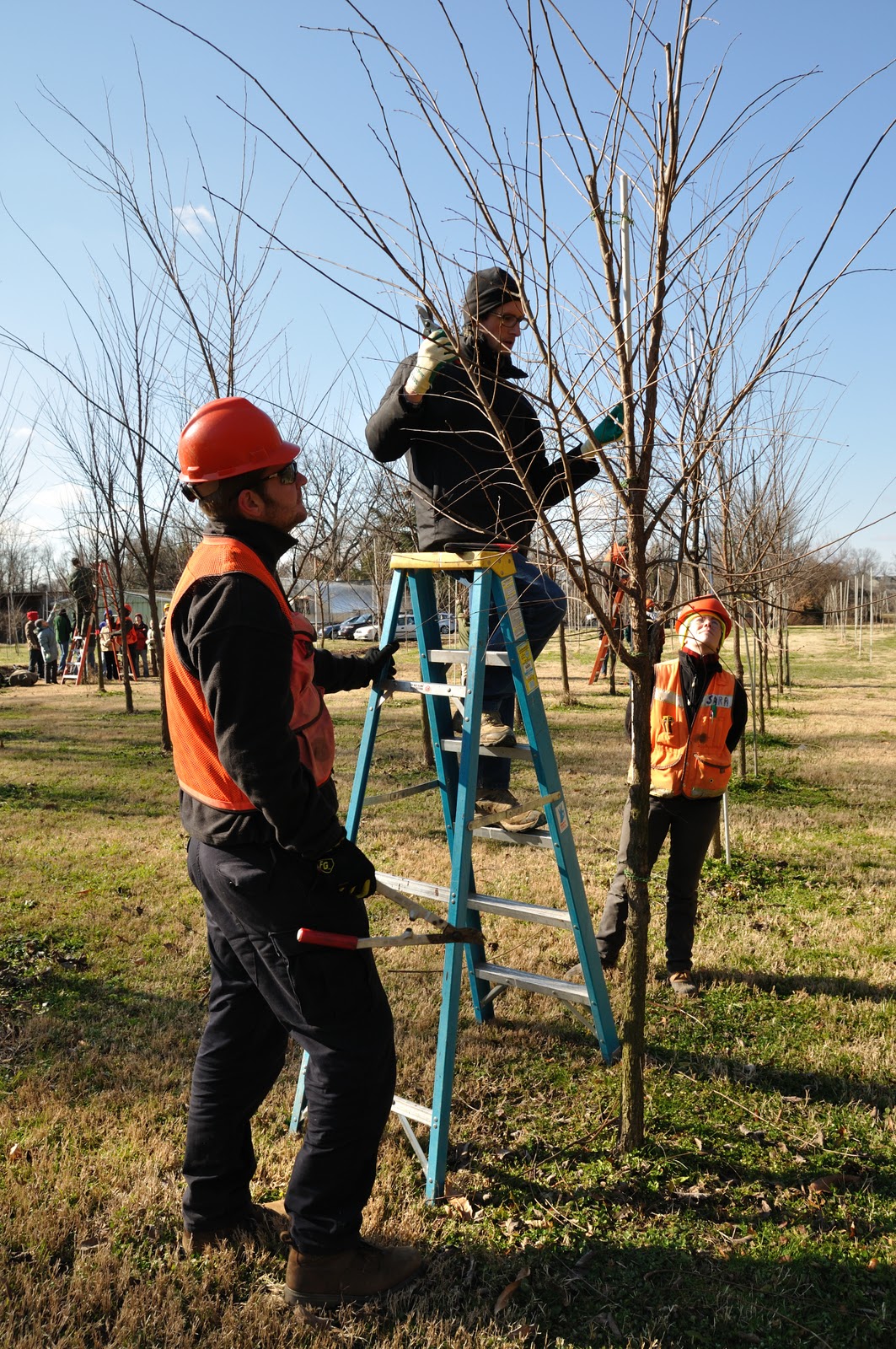
Casey Trees loves an American elm! Each winter we plant approximately 200 American elm cultivars through our American Elm Restoration program along designated corridors and provide structurally pruning to those we've planted in years past. The result? A healthier tree canopy for the District. 

Barry Stahl, U.S. National Park Service Horticulturist, demonstrates a pruning technique.

To help our staff and Citizen Foresters fine-tune their pruning skills, we also partner with the Barry Stahl, Horticulturist with the U.S. National Park Service (NPS) at Daingerfield Island on the George Washington Parkway. The on-site American elm nursery is unique since it provides the NPS with a continuous supply of native elms, as well as disease resistant and historically significant elm cultivars that are not commercially available.


Those lucky enough to get a spot in last Saturday's pruning workshop learned about the history of American elms in the U.S. and D.C., Dutch elm disease (boo!), proper pruning tools and techniques and much more. Immediately afterward, participants practiced their new and/or strengthened pruning skills on five-year-old American elms grown from seed right at the nursery.

We've put together a video montage profiling the workshop (below) and uploaded some great photos onto our Flickr page. Check them both out.


If you would like to learn more about trees, consider registering for one or all of our Citizen Forester-qualifying courses - Trees 101 (Sat., Jan. 21), Stand Up for Trees (Sat., Feb. 4) and Tree Planting (Sat., March 3). Already tree savvy or a Citizen Forester? Think about Trees 201 (Sat., Jan. 28). All classes are free but require advance registration.

Friday, January 13, 2012

New Year's Resolution Already Failing You? Let Casey Trees Help!

It's already the second week of 2012 which means you've probably already given up on that fool-proof New Year's resolution you swore to yourself you'd stick to.

You know – the annual lose weight, quit smoking, exercise more aspiration that lasts just a few weeks before the temptation and stresses of everyday life set in? Yes, that one.

Well this year, why don't you try something different?

More and more people are trading in their yearly self-improvement resolutions, and instead are looking to make the New Year a charitable one. Think about giving your New Year's resolution a much-needed makeover and add “giving back” to your list of goals for 2012. It's an easy goal to keep and more times than not can give you the personal satisfaction those hours on a treadmill couldn't.

At Casey Trees we have a number of opportunities that can help you achieve your New Year's Resolution, and at the same time help our city and your neighbors. Here are a few ways for you to reach your 2012 charitable goal:
  • Donate/Become a Sponsor. As a non-profit, Casey Trees relies on the generosity of people like you to add trees to our city's parks, schools, and neighborhoods throughout the year. Consider making a tax-deductible donation this year. You can also make a larger gift and sponsor a Tree Planting event ($2,500) or one of our High School Summer Crew members ($4,000) and make a difference in a young person's life this year.
  • Volunteer. Casey Trees offers volunteer opportunities for people of all ages and skill levels from our tree planting events in the spring and fall, to our tree care programs, and advocacy work. Those looking to have a more proactive world should consider becoming a Citizen Forester. You can register for our volunteer events online through our Events Calendar.
  • Take a Class. Casey Trees hosts free year-round educational courses on topics ranging from basic tree biology to proper tree care to community advocacy training classes. Attending one of our classes also qualifies you as a Casey Trees Citizen Forester.
Try something a little different and join Casey Trees this New Year and make that 2012 resolution a success.